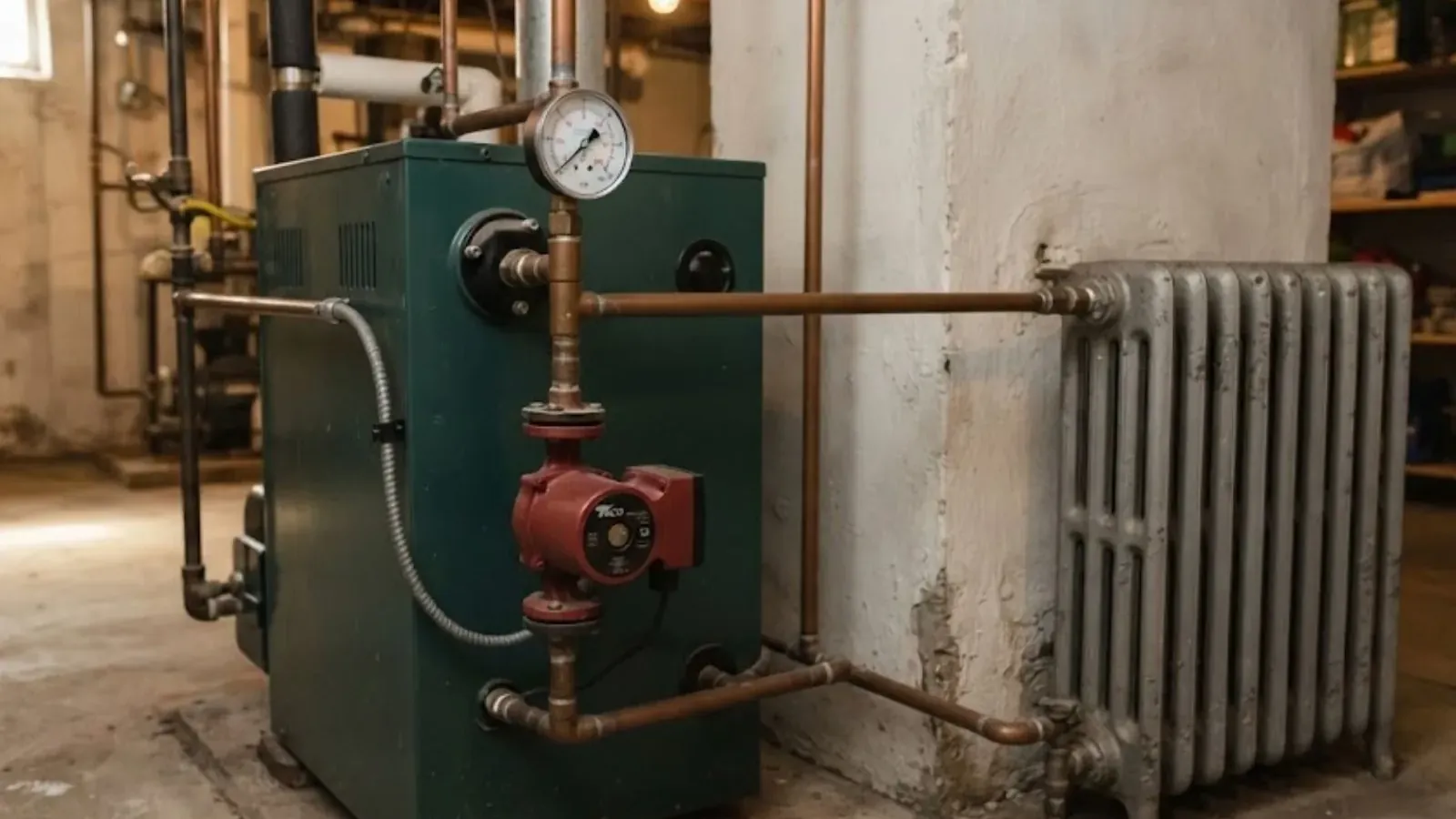
Boiler symptoms and what they usually mean
| Symptom | What it often points to |
|---|---|
| No heat, no hot water | Failed ignition, tripped safety, no fuel or power, or a dead circulator |
| Radiators cold at the top | Trapped air that needs bleeding |
| Gauge reading low | Water loss from a leak, or a failed expansion tank |
| Banging or kettle-like noise | Scale buildup or low water flow |
| Water on the floor | Leaking valve, pump seal, expansion tank or boiler body |
| Boiler cycles on and off quickly | Oversized load, a dirty sensor or a flow problem |
Many of these are fixable in one visit. A leak from the boiler body itself, or a heat exchanger that has cracked, usually is not.
Before we arrive: safety first when the heat is out
A boiler brings fuel, water and electricity together. A few checks are safe and help us.
Smell gas? Leave
If you smell gas or rotten eggs, leave the house and call the gas utility from outside. Do not flip switches. Call us after.
Check the basics
Look at the thermostat, the power switch on or near the boiler, the breaker and the fuel supply. For oil, check the tank gauge.
Read the gauge
Note the pressure and temperature. Most home boilers sit around the low end of the dial when cold. Write down any error code.
Do not keep resetting
One reset is fine. Repeated resets can flood the combustion chamber or wear out the ignition.
How a no-heat call is worked
- 1
Safety check
Gas smell, carbon monoxide readings, venting and flue draft are looked at first.
- 2
Run the boiler through a cycle
We watch ignition, flame, circulator and zone valves to find where the sequence stops.
- 3
Replace the failed part
Ignitors, flame sensors, pumps, relief valves and zone valves are common repairs.
- 4
Bleed, balance and test
Air is removed from the radiators, pressure is set and each zone is checked for heat.
Cold house and no boiler response?
Call (973) 488-5410 any hour. We'll walk through the safe checks while we arrange a visit.
Older neighborhoods and older boilers
The Ridgewood Public Library's local-history pages describe neighborhoods that date to different eras, including Brookside around 1890, Floral Park in the 1910s and The Heights between 1892 and 1930. Homes of that age often kept their original heating layout, even when the boiler has been replaced.
That matters for repairs. Older steam and hot water radiator systems have long pipe runs, many valves and parts that can be hard to match. A modern boiler paired with old piping may need balancing or new vents to heat evenly.
We do not assume a house's age from its address. We look at the boiler, the pipes and the distribution before saying what is practical.
Repair or replace the boiler
Repair makes sense when
- The failed part is a pump, ignitor, sensor or valve
- The boiler is otherwise clean and quiet
- The heat exchanger shows no cracks or heavy leaks
- The unit has not needed repeated major repairs
Talk replacement when
- The heat exchanger or boiler body leaks
- Repair parts are discontinued
- Repairs keep coming back in the same season
- Efficiency has dropped and fuel use keeps rising
According to the New Jersey State Board of Examiners of Master Plumbers, plumbing work may only be performed by a master plumber or an authorized plumbing contractor. The state plumbing subcode adopts the 2021 National Standard Plumbing Code (N.J.A.C. 5:23-3.15), the standard we work to on the water side of a boiler. Gas and oil burners have their own requirements, and we tell you plainly which parts of a job we handle and which need a specialist.
If the boiler also feeds your domestic hot water, see water heater repair for the related tank-side work. A leaking boiler can mimic a pipe leak, so a leak detection visit sometimes helps pin down the source. Customers in Glen Rock can find nearby coverage on the Glen Rock page.
What shapes the price of a boiler repair
A pump swap and a heat exchanger are different jobs. You get a clear price before work starts.
We give the price for the repair and for replacement, so you can compare both.
Boiler down and the house cooling?
Call (973) 488-5410. Our phone line is open all night.
Boiler questions homeowners ask
The boiler may be heating but the circulator, a zone valve or trapped air is stopping the heat from moving. We trace the flow.
A slow leak, a failing expansion tank or a bad relief valve. Topping up without finding the cause just hides the problem.
Usually not. A small leak at a valve can be shut down and repaired, but a leaking body is not safe and the boiler should be turned off.
Turn the small valve at the top with a key or screwdriver until water spits, then close it. Do it with the boiler cool and a towel handy.
Yes, along with gas. Oil burners also depend on a clean fuel supply, which we check.
Yes. A boiler with bad venting can produce it. Have working carbon monoxide detectors and leave the house if one sounds.
We aim to restore heat as fast as parts and conditions allow, and we tell you honestly if a part must be ordered.