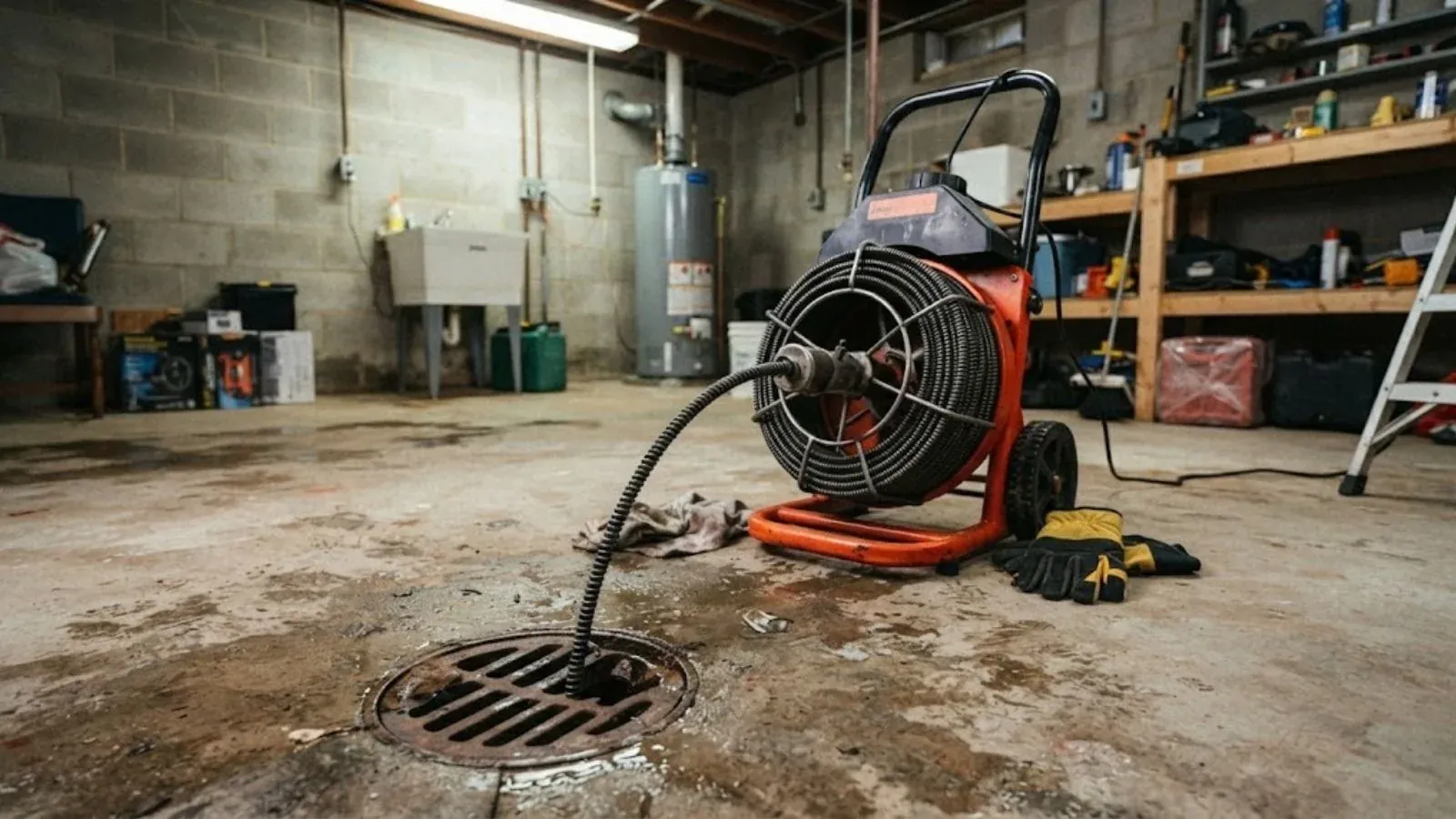
Which drain is the problem
Where the water backs up tells you how serious the clog is. One fixture is usually a local blockage. Several fixtures at once point at the main line.
One sink or tub
Hair, soap film and kitchen grease collect in the trap and the first stretch of branch pipe. These clear with a hand auger or small cable.
Toilet and tub gurgling together
Air is being pushed back through the traps because the line downstream is partly blocked. This is the early stage of a main line problem.
Basement floor drain
A floor drain that burbles or overflows when the washer runs is connected to the main line. The clog is usually past the branch.
Laundry standpipe
Lint and detergent residue build up fast. Water rising in the standpipe during the spin cycle is the warning.
Signs the main line is clogged
- Two or more fixtures drain slowly at the same time
- Water or sewage shows up in the lowest drain in the house when you flush or run a load
- A sewer gas smell near a floor drain or cleanout
- Bubbling in a toilet when the washer discharges
- A cleanout cap that is wet or stained
Any of these is worth a call the same day. A main line that is only slow today can stop completely when the next shower or load of laundry runs.
Cable, jet or camera first
The right tool depends on what is in the pipe. We choose after hearing the symptoms and looking at the access.
| Method | Best for | Limit |
|---|---|---|
| Hand or drum cable | Sink, tub and branch clogs, hair, paper, soft blockages | Opens a hole through grease and scale but may leave the wall coated |
| Heavy main line cable with cutter | Roots and stubborn main line stoppages | Cuts a path, roots regrow if the pipe is cracked |
| Hydro jetting | Grease, scale and sludge on pipe walls | Needs a sound pipe, camera check first on old lines |
| Camera inspection | Repeat clogs, a collapsed pipe or an unknown cause | Finds the cause, does not clear the clog itself |
Emergency: when a drain backs up tonight, do this first
What you do in the first few minutes decides how much cleanup follows.
Stop the water
Do not flush, run the washer or use the dishwasher. Every gallon you add has to go somewhere, and the lowest opening is usually your basement.
Find the cleanout
Look for a capped pipe near the main stack in the basement or at the outside foundation. Knowing where it is saves time when we arrive. Do not open it if sewage is rising.
Protect the floor
Lift boxes and electronics off the floor and keep children and pets out of wet areas. Sewage water is not safe to touch bare handed.
Skip the chemicals
Liquid drain openers sit in a standing clog and can burn skin and pipe. Tell us if you already used one so we can work safely.
Water still rising?
Call now. We will talk you through what to leave alone and plan the cleaning while you wait.
What a cleaning visit includes
- 1
Locate and test
We confirm which fixtures are affected, find the nearest access point and run water to see how the line behaves.
- 2
Clear the line
A cable of the right size goes in through a cleanout, trap or vent. We feed it until the blockage gives way and pull back what we can.
- 3
Flush and verify
We run water through every affected fixture and the main to confirm full flow, not just a hole in the clog.
- 4
Tell you what we found
Roots, grease, a belly or a bad joint get explained. If the pipe needs a camera or a repair, we say so plainly.
Why Ridgewood lines clog and come back
The local library's history pages show Ridgewood neighborhoods built between the 1890s and about 1950, so many sewer laterals are decades old. Village code calls for cast iron or vitrified clay house sewers beyond three feet from a building. Both materials can develop rough joints and cracks where roots and debris catch.
If you keep getting the same clog, the answer is rarely a stronger cable. It is a camera look to see whether the pipe has a belly, a root intrusion or a broken joint, which leads into sewer line repair.
There is also a village rule that matters in a backup. According to Chapter 238 of Ridgewood's code, a groundwater sump may not be connected to a discharge point tied to the sanitary sewer. A pump tied into the sewer can overload the line in heavy rain, so tell us if your sump discharges anywhere near a floor drain.
What affects drain cleaning cost
A single sink and a buried main line are very different jobs, so we price by what we find.
You hear the price before the cable goes in.
If the clog is grease heavy, ask about hydro jetting. For a backed up line that also shows signs of root damage, a sewer line repair crew can scope it. Homes in Wyckoff and other nearby towns call us for the same reasons.
Clog won't clear?
Call Ridgewood Pro Plumbing. We will find the blockage and tell you what keeps it from coming back.
Questions homeowners ask
Our line is answered 24/7. Describe what is backing up and we will say what we can do and what to avoid until a plumber arrives.
A cable opens a hole through the blockage but may leave grease or scale on the walls. A cracked pipe or a root intrusion also brings clogs back. A camera look or jetting usually settles it.
We advise against it. Chemicals sit in a full pipe, do not clear solid blockages and can injure whoever opens the trap afterward. If you already used one, tell the plumber.
That can point to stormwater or groundwater reaching the sewer. Ridgewood's code bars sump and groundwater discharge to the sanitary sewer, so we check how your sump and gutters are routed.
Yes, we work in apartments, small shops and mixed use buildings. Grease traps and restaurant lines are scoped differently, so say what kind of building it is when you call.
Call for one if the same line has clogged more than once, if you smell sewage without a visible backup, or if you are buying a house. The video shows exactly what is in the pipe.