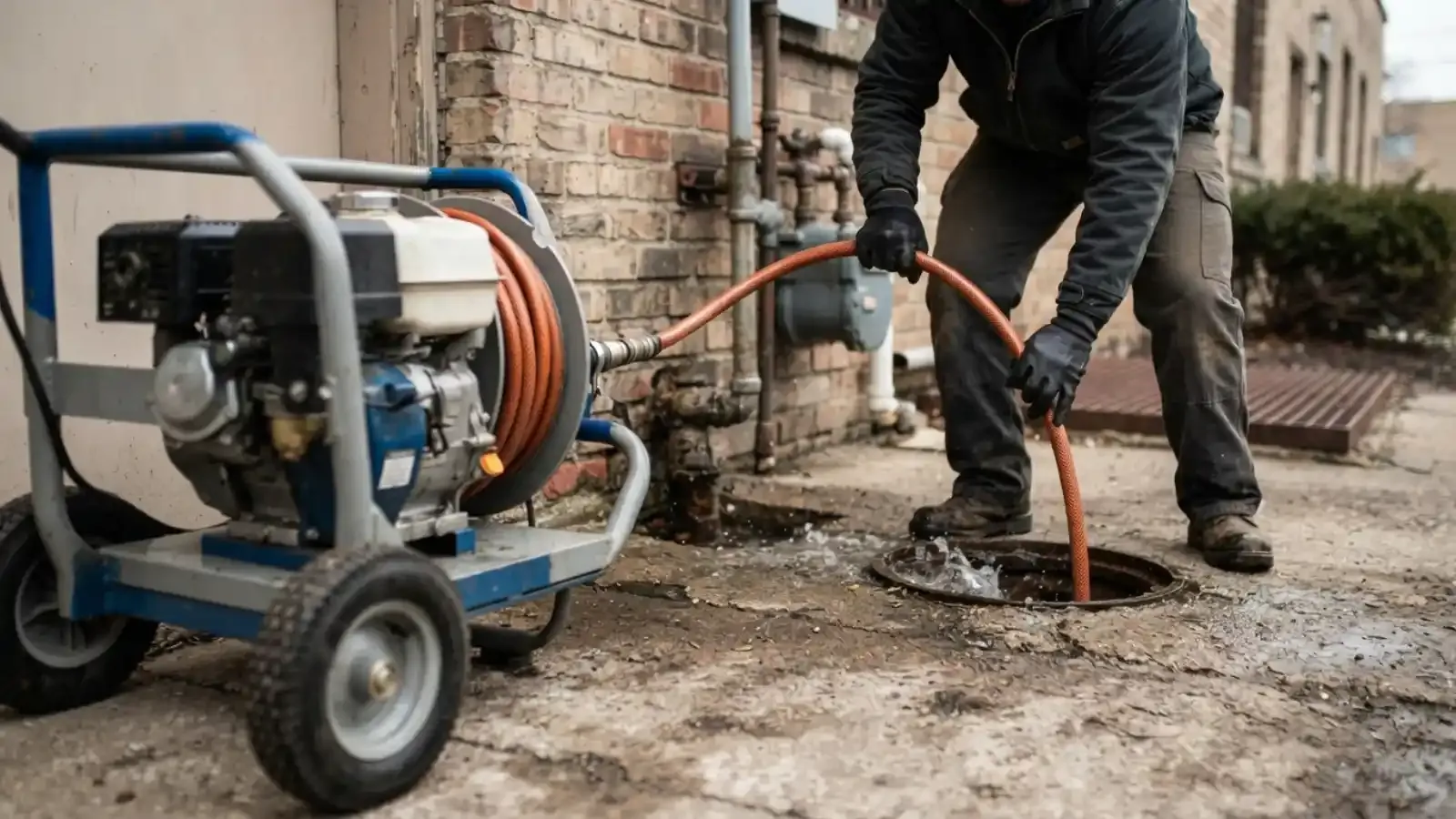
What hydro jetting does differently
A jetter feeds a flexible hose with a nozzle into the pipe. Water leaves through angled jets that push the nozzle forward and spray backward, stripping buildup from the pipe wall as it returns.
The result is a line scrubbed close to its full diameter, not a narrow channel through the middle. That matters for pipes that clog again within weeks after a cable pass.
Jetting or cabling
Hydro jetting suits
- Grease and soap scum coating the pipe
- Mineral scale and sludge buildup
- Root fibers left after a cutter pass
- Annual maintenance on a problem main line
Cabling suits
- A single hard stoppage such as a toy or a mass of paper
- Sink, tub and shower branch clogs
- Lines too fragile or too small for jetting
- Quick relief when the line is fully blocked
Often the answer is both. A cable can open a completely blocked line so that the jetter can clean it. Our drain cleaning service covers cabling and the camera work in between.
Signs a line is ready for jetting
- The same drain clogs every few weeks despite repeated cabling
- Slow drains in several fixtures with no single blockage found
- Gurgling and a sewer gas smell with no visible backup
- Grease from a kitchen line or a restaurant floor drain
- Roots cut earlier that are now growing back
When jetting is the wrong tool
We scope the pipe first
High-pressure water can worsen a cracked, offset or collapsed pipe, and it can push loosened debris into a belly. That is why we run a camera before we jet an unknown line, particularly an old one.
If the camera finds a break, the answer is repair, not more pressure. Go straight to sewer line repair and clean the line afterward.
Emergency steps if the line has backed up
If wastewater is coming up through a floor drain, tub or toilet, do this while you wait.
Stop using water
No flushing, laundry, dishwasher or showers. Water you add has nowhere to go but out of the lowest drain.
Keep the cleanout reachable
Clear boxes and stored items from around the cleanout so access is quick. Leave the cap on if sewage is rising.
Do not add chemicals
Drain openers leave caustic liquid in the pipe and can injure whoever works on it.
Guard the floor
Lift valuables, put down towels and keep children and pets clear until the area is cleaned.
Main line gurgling or backing up?
Call and tell us how long it has been happening. We will plan the right cleaning.
The jetting process
- 1
Find the access
We locate the cleanout or the right entry point such as a pulled toilet, and protect the floor.
- 2
Camera look
A camera shows the pipe condition and the type of buildup. This decides whether jetting is safe.
- 3
Jet the line
We feed the hose forward, then pull back at a steady rate so the spray scours every foot.
- 4
Verify the result
We camera or flow-test the line again and show you what changed.
Ridgewood pipes and the jetting decision
According to the Village sewer ordinance in Chapter 238, house sewers must be cast iron or vitrified clay beyond three feet from the building, and parts of Ridgewood date from the 1890s through about 1950. Old pipes can carry heavy scale and roots, which suits jetting, but they can also be fragile at the joints.
Ridgewood Water's published reports show hardness from about 136 to 470 parts per million. Hard water leaves mineral scale on pipe walls over the years, and jetting is one of the few ways to remove it without scraping the pipe.
A check on the pipe and a cleaning plan fit together. If the camera shows a damaged lateral, we explain the fix, and if the line is sound, we jet it and tell you how often to repeat it. A restaurant or shop on Ridgewood Avenue, or a multi-unit building, may need a regular schedule.
What affects hydro jetting pricing
Jetting is priced by the work involved, not by a flat rate.
We quote jetting after we know what is in the line.
We jet drain and sewer lines in Ridgewood and nearby towns, including Midland Park. For a main line that needs routine cabling instead, we offer sewer line cleaning.
Same clog, again?
Call Ridgewood Pro Plumbing. We will look at the line and tell you whether jetting is the right fix.
Questions homeowners ask
It depends on the pipe. Sound cast iron and clay can be jetted, but cracked or collapsed pipe can be damaged. That is why we run a camera first.
Lines with a grease or scale history may benefit from a yearly cleaning. Lines with root problems may need it more often, unless the cause is repaired.
It cuts fine root fibers and clears debris. Heavy root masses are usually cut with a cable first, then jetted. Roots return if the pipe has an open joint.
No. A collapse needs repair. Jetting a collapsed pipe will not restore flow.
Someone should be there to show us the cleanout and to sign off on the result. The work itself is done outside or in the basement.
It can be. If a line has backed up and cabling cannot hold, jetting may be the next step. Call and we will tell you what to expect.