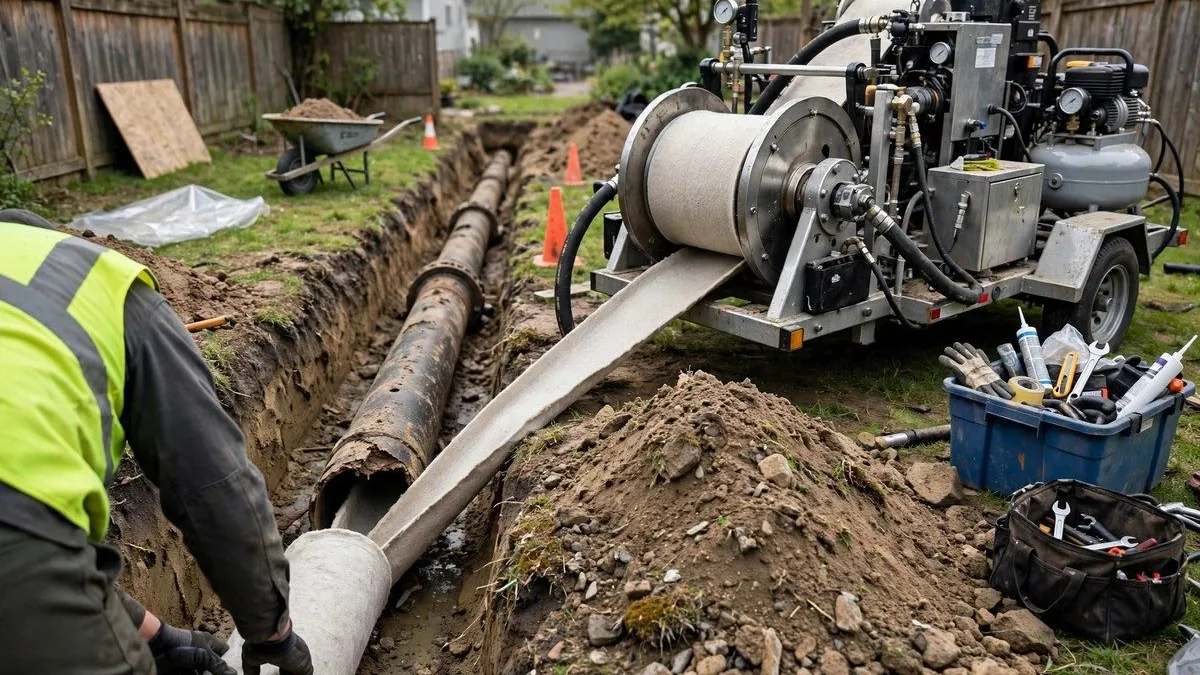
What goes wrong with a house sewer
A sewer lateral is out of sight, so failures tend to announce themselves late. Knowing the common failure types helps you describe the problem and understand the repair.
Root intrusion
Fine roots enter at joints seeking moisture, then thicken into a mat that catches paper and waste. Cabling clears them and they return.
Cracked or broken pipe
Clay and cast iron can crack from age, settling, heavy loads or ground movement. Soil then washes into the pipe.
Belly or sag
A low spot holds water and solids. The line drains slowly and clogs in the same place over and over.
Collapse or offset joint
A section drops or shifts. Cables stop at the obstruction and the line backs up completely.
Signs the problem is in the lateral
- Several drains back up at once, especially the lowest one in the house
- Repeated clogs in the same line a few weeks after cleaning
- Gurgling toilets and sewer gas smells near floor drains
- Wet or sunken patches in the yard along the path of the line
- Cable machines stopping at the same distance each time
If the same line has clogged more than once, skip another round of drain cleaning and get the pipe looked at. A short video often shows a problem a cable never will.
Emergency steps before we arrive
A blocked lateral sends wastewater to the lowest open drain. These steps reduce the cleanup.
Stop all water use
No flushing, showers, laundry or dishwasher. Every drop adds to the backup.
Leave the cleanout alone
Do not open a cleanout cap while sewage is rising behind it. Show us where it is when we arrive.
Keep people clear
Keep children and pets away from wet areas. Wear rubber gloves and boots if you must move things, and wash up afterward.
Move valuables
Lift furniture, boxes and electronics off the floor. Turn off the breaker for any outlet in standing water only if you can reach it dry.
Line completely blocked?
Call now. We will talk through containment and start planning the repair.
Choosing the repair method
The camera shows what the pipe needs. The right fix depends on how much of the line is damaged, where it sits and what is above it.
| Method | When it fits | Trade-off |
|---|---|---|
| Spot repair by excavation | One broken section, collapse or offset joint | Needs a trench, restores that section only |
| Pipe lining | Cracks, root-prone joints, long runs under hard surfaces | Needs a pipe that is not collapsed, sizes shrink slightly |
| Full replacement | Extensive damage, bellies or failed old material | Largest scope, new pipe over the full run |
| Cleaning and monitoring | Light root growth in sound pipe | Buys time, does not repair |
Before lining or digging, the pipe should be cleared and scanned so the repair is based on what is really there. If the line is only grease or scale coated, hydro jetting may clear it without repair.
What a Ridgewood lateral is made of and why it matters
Ridgewood's village code calls for house sewers to be cast iron or vitrified clay beyond three feet from the building, and to be set deep enough to be protected from frost. New Jersey's plumbing subcode adopts the 2021 National Standard Plumbing Code (N.J.A.C. 5:23-3.15), so a repaired lateral is built to that standard as well. Both materials have lasted a long time, but clay joints and old iron can crack, rust through or let in roots.
The Library's neighborhood history dates parts of Ridgewood to the 1890s and the 1910s, and others to the 1930s and 1950. Where a lateral has served a house for generations, we expect to see old joints, and a camera tells us whether they are still tight.
Stormwater is another source of trouble. Village code bars sump pump and groundwater discharge from being tied into the sanitary sewer, and violations carry fines and a monthly surcharge. If your pump is piped to the sewer, expect a backup in heavy rain, and plan to correct it as part of the repair. The village also runs its own wastewater treatment plant, so any permit or inspection questions go through the village.
How the repair process runs
- 1
Clear and scan
We clear the line enough to pass a camera, then record its length, material and defects.
- 2
Locate and plan
We mark the defect location on the surface and explain the options with a price.
- 3
Repair
We excavate, line or replace as planned, with the trench or access pit kept as small as the job allows.
- 4
Test and restore
We run water and verify flow, then backfill and tell you what site restoration is needed.
What drives sewer repair cost
A short repair in a yard and a long run under a driveway are not comparable, so there is no single number.
You see the full scope and price before digging starts.
We repair laterals in Ridgewood and in neighboring towns, including Fair Lawn. If you are buying a house or digging near the line, a sewer camera inspection shows the condition first.
Sewer backing up?
Call Ridgewood Pro Plumbing. We will find the break and tell you how to fix it.
Questions homeowners ask
If the same line keeps backing up, or the cable stops at the same point each time, the pipe itself is probably damaged. A camera confirms it.
No. Lining or a small access pit can repair some failures without a long trench. A collapse or severe belly usually needs excavation.
Yes. Roots follow moisture to joints and cracks and grow inside the pipe. Cutting them is temporary if the opening remains.
Yes. Sewage in living space is unsanitary and spreads. Stop water use and call right away.
Where permits or inspections apply to the work, we handle that with the village and tell you what to expect.
Ridgewood's code prohibits that. We will point out the connection and what it takes to reroute the discharge.