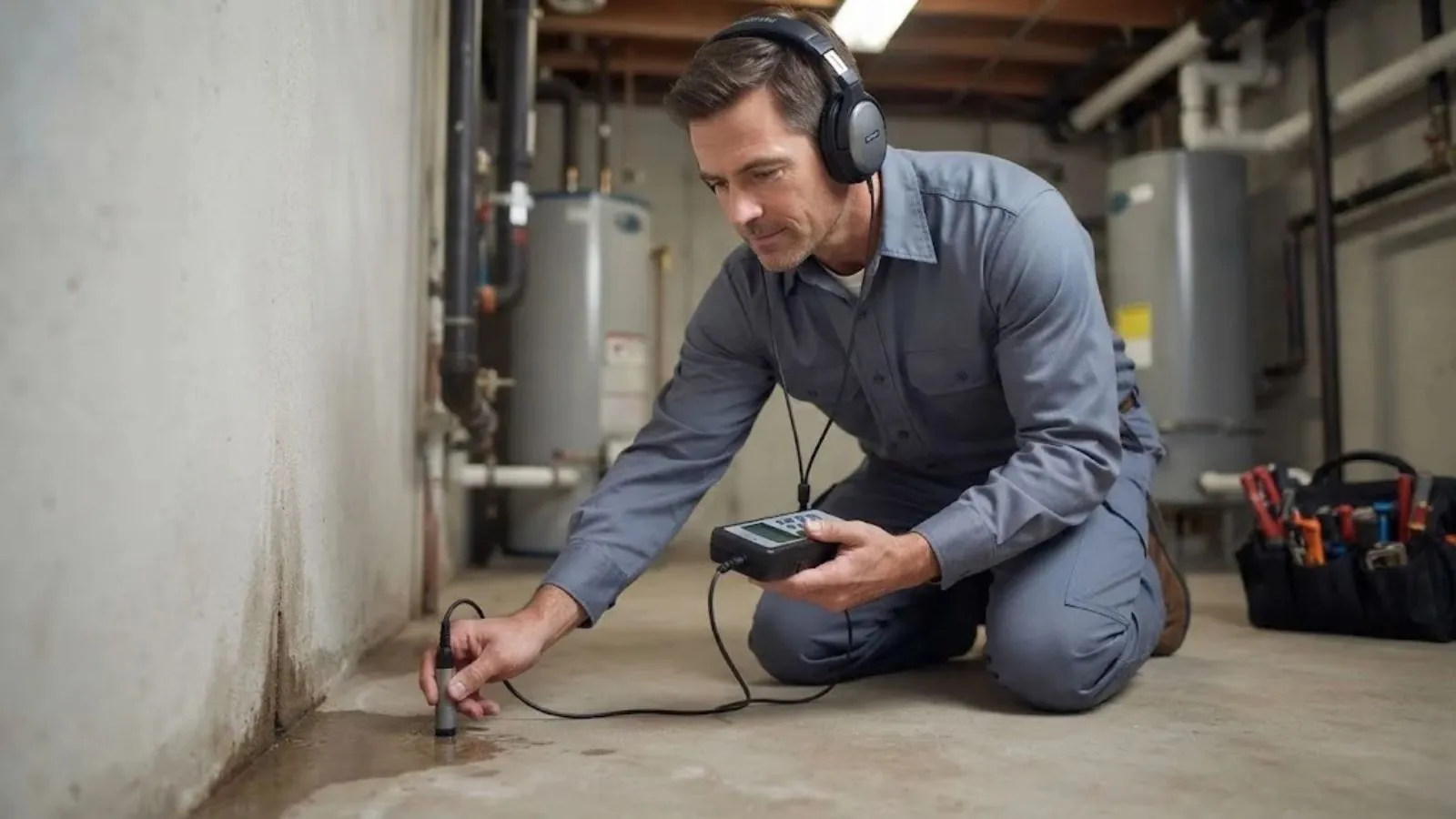
Clues that point to a hidden leak
A bill that keeps creeping up
If usage rises with no change in your household, water is going somewhere. Check a few months of bills against each other.
A meter that never stops
With every tap and appliance off, a moving meter dial means water is leaving the system.
Damp, stained or bubbling surfaces
Brown rings on a ceiling, paint that peels, warped baseboards or a musty smell often trace back to a slow pipe leak.
Water noise with nothing running
Hissing or trickling in a wall suggests a pressurized line is leaking. Low pressure at fixtures can say the same thing.
Any one of these is worth testing. Two together mean it is time to call, because slow leaks rot framing and feed mold while you wait.
A meter test you can run tonight
- Turn off every tap, the dishwasher, the washer and the ice maker. Make sure nobody flushes.
- Find your water meter and note the reading, or watch the small leak indicator dial if it has one.
- Wait fifteen minutes without using any water, then look again.
- If the reading moved, water is escaping. Close the main shutoff and check whether the meter stops. If it does, the leak is inside the house. If it keeps moving, the leak is on the line between the meter and the shutoff.
That last result is the most useful clue you can give a plumber. It cuts the search in half before we arrive.
How we trace it without tearing things apart
- 1
Isolate the system
We close sections of the plumbing one at a time and watch the meter to narrow the leak to a branch or zone.
- 2
Pressure test
Holding pressure on a section tells us whether it leaks, which separates supply lines from drain problems.
- 3
Listen and read
Acoustic listening and moisture readings pinpoint the spot on a wall, floor or buried pipe.
- 4
Mark and report
We mark the location, explain the cause and lay out the repair so you are not paying to open more drywall than needed.
Emergency steps if water is escaping right now
An active leak should be stopped and contained first, then located.
Close the main shutoff
Find the valve where the water line enters the house, often near the meter in a basement. Turn it clockwise until it stops.
Open the lowest tap
With the main off, run a faucet to relieve pressure and drain what remains in the pipes.
Cut power near water
If water is near outlets, an appliance or the electrical panel, turn off the breaker for that area, but only if you can reach it dry.
Photograph and mop up
Take photos of stains and wet areas for your records, then remove standing water and open windows to help drying.
Think you have a leak?
Call and tell us what the meter, the bill or the wall is doing. We will plan the test.
Where the water goes in Ridgewood
According to the New Jersey Infrastructure Bank, Ridgewood Water has identified more than 3,000 service lines that are wholly or partly lead, and state law requires lead and galvanized service lines to be found and removed by 2031. The utility owns the section from the main to the curb, and the homeowner owns the stretch from the curb to the building.
That private stretch is where a meter leak often hides, because it is buried and out of sight. If we find an older line failing there, the fix may be tied to the lead line replacement process, and we coordinate with Ridgewood Water as the program requires. For that work, see water service line repair.
Frost depth matters too. The state construction code table sets 36 inches of frost depth for northern New Jersey, and water lines are meant to be buried below that depth. A line laid shallow or disturbed by later digging is more exposed in a hard freeze. A frozen split near the surface is a different story, and burst pipe repair covers it.
Leak detection first
- Pinpoints the pipe before anyone cuts
- Limits damage to drywall, tile and landscaping
- Shows whether the leak is supply or drain
- Gives you a documented location for repairs or insurance
Opening walls to look
- Guessing can miss the leak entirely
- Cuts and patches cost more than the test
- Leaves holes in finished rooms
- May still need detection afterward
What affects leak detection pricing
The work ranges from one test at the meter to tracing a buried line under pavers.
We give the price once we understand the scope.
Not every wet spot is a supply leak. A damp basement corner can come from a drain, so a sewer line repair check or a look at drain cleaning history helps sort it out. We handle calls in Ridgewood and in nearby towns such as Waldwick.
Water going somewhere?
Call Ridgewood Pro Plumbing. We will test, locate and explain the leak before anything gets cut open.
Questions homeowners ask
Close the main shutoff and watch the meter. If it stops, the leak is inside. If it keeps moving, the leak is on the underground line before the shutoff.
Often yes. We narrow it by testing and listening, then open only the section that needs it. A small, clean access hole is better than a large exploratory cut.
Ridgewood Water owns the section from the main to the curb. The homeowner owns the private side from the curb to the building. Utility rules apply when a lead line is involved.
No. Lawn watering, a new family member or a running toilet can raise it. A meter test with everything off quickly tells you whether it is a leak.
Soon. Even a slow pinhole can soak insulation and framing over weeks. If the meter is moving at all, schedule a test.
Yes. We find it, explain the repair and fix it, or hand you the written location if you prefer to use someone else.