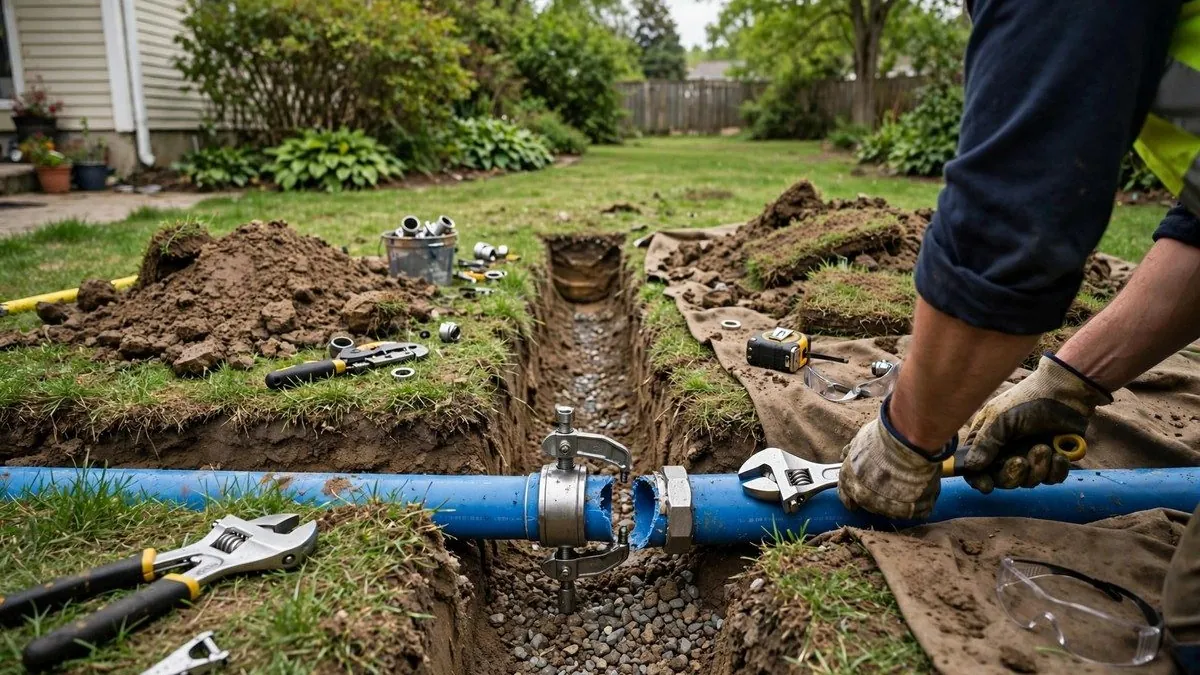
How a failing service line shows itself
A service line fails quietly for a long time and then all at once. Because it is buried, most people notice the effects before the pipe.
These are the signs we hear about most, usually in this order.
- Water pressure that has dropped at every fixture, not just one faucet
- A soft, soggy or unusually green strip of lawn between the street and the house
- A water meter that keeps moving after every tap and appliance is off
- A hissing or rushing sound where the line enters the basement wall
- Muddy or discolored water right after pressure dips
- A water bill that has climbed with no change in how you live
What to do before we arrive when the line is leaking
A service line leak can flood a basement fast. These steps slow it down.
Shut the main valve
Find the main shutoff where the line enters the house, usually in the basement near the meter, and turn it fully closed. If the handle is stuck, do not force it with a wrench.
Check the meter
With everything off, watch the meter dial. If it still moves after the main valve is closed on the street side, the leak is outside before your valve.
Clear the entry area
Move boxes, stored items and electronics away from the wall where the pipe comes in, and unplug anything near standing water.
Keep the shutoff key near
If the meter pit has a curb stop, do not open it yourself. Note where it is and tell us on the call.
Who owns which part of the line
In Ridgewood the pipe is split in two. The public side, from the main to the curb, belongs to Ridgewood Water, the Village utility. The private side, from the curb to your building, belongs to you.
That split matters on the first call. A leak on the public side is a utility repair. A leak on the private side is yours to fix, and a licensed plumber can usually tell which side by looking at the meter, the shutoff and the wet ground.
If you are unsure, call Ridgewood Water at 201-670-5520 to report the leak while we plan the private-side work.
Meter spinning and no taps open?
Call (973) 488-5410. We can often tell from your description whether the problem is inside or under the yard.
Lead service lines and New Jersey's 2031 deadline
New Jersey law requires water systems to find and remove all lead and galvanized service lines by 2031. Ridgewood Water has identified more than 3,000 lines that are wholly or partly lead, and the utility runs a replacement program with an opt-in and opt-out step for customers who are notified.
If you hire your own contractor for the private side, the work has to be coordinated with Ridgewood Water at 201-670-5520. That keeps the public and private halves matched so you do not end up with a new pipe joined to an old lead one.
Before any digging, we confirm the pipe material at the entry point. A magnet and a scratch test tell a lot, and the utility's notice tells the rest.
Repair, replace or reline
- 1
Find the leak or break
We use the meter test, listening gear and a camera or locator where needed to pinpoint the failure.
- 2
Choose the method
A short spot repair, a full replacement run or a trenchless pull can all fit, depending on the pipe and what sits above it.
- 3
Dig, pull or tunnel
We excavate only what is required, and we call 811 before any ground is opened.
- 4
Pressure test and restore
The new pipe is tested before it is covered, the shutoff is checked, and the trench is backfilled.
Depth matters in northern New Jersey. According to the frost depth table in the state construction code, the northern half of New Jersey uses three feet, so any new line has to be buried below the freeze zone. A shallow old pipe is one of the reasons a service line splits in a hard winter, a failure that overlaps with burst pipe repair.
When the line is damaged, it is also worth checking the inside piping, because pressure surges after repair can show weak spots. A leak detection visit before the trench closes can save a second dig. For a home in Midland Park, which is also served by Ridgewood Water, see the Midland Park page.
What drives the cost of a service line job
Every yard is different, so the price is set after the plumber has seen the line. You get a clear price before work starts.
Ask what the price covers, including restoration of the lawn or paving, before you agree.
Water line failing?
Call (973) 488-5410 any hour. We will help you find the shutoff and plan the repair.
Service line questions homeowners ask
It is usually on the wall where the pipe enters the basement or utility room, near the meter. Turn the handle clockwise until it stops.
The utility owns the public side up to the curb. The private side from the curb into your house is the homeowner's. Ridgewood Water's program covers the process for notified customers.
A magnet will not stick to lead, and a scratch shows shiny silver metal that is soft. The line is the pipe entering at the meter. The utility's notice letter is the formal answer.
It depends on the method and how deep the line sits. We tell you what to expect before the work starts and we work to restore service as soon as the new pipe passes its test.
It depends on the scope. The Village Department of Building and Inspections enforces the code, and we confirm what applies before any work starts.
Sometimes. Trenchless methods can pull a new pipe through the old path. Whether it fits depends on the pipe's condition and the soil.
Report it to Ridgewood Water at 201-670-5520. We can still confirm from the meter and shutoff that the leak is on the public side.