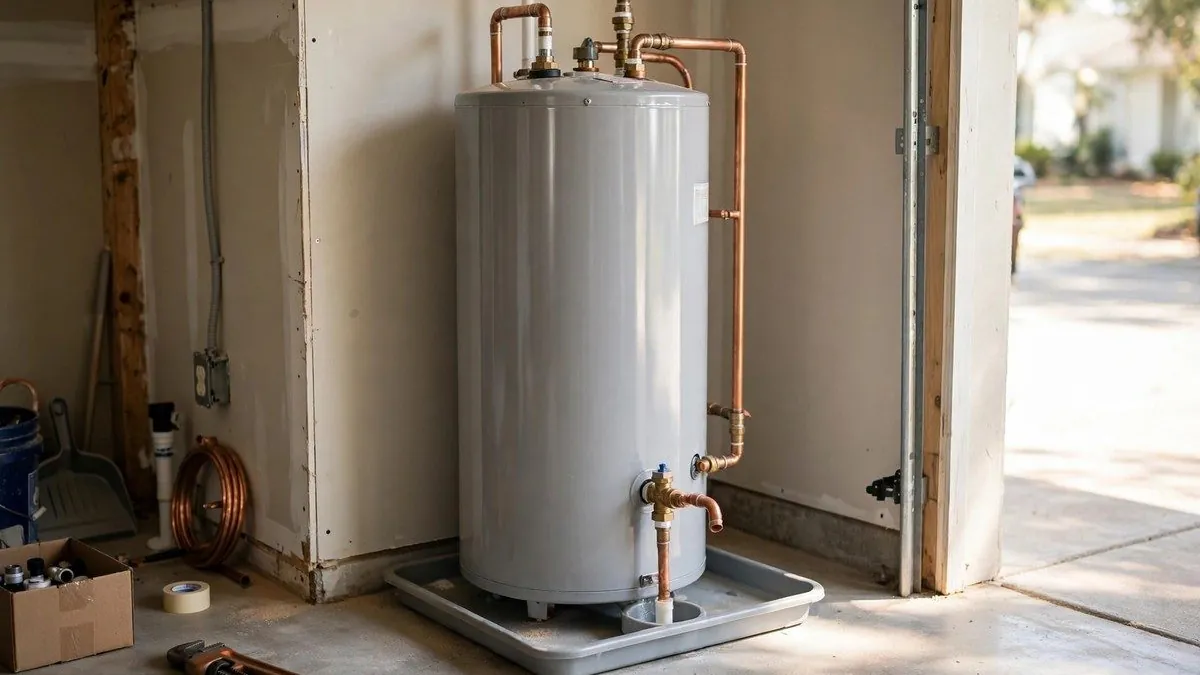
Signs the tank is finished
Most tanks give a few warnings before they let go. The trouble is that they are easy to ignore when the water is still hot enough to shower.
Some signs point to a repair, and a few mean the steel itself is giving up.
Water at the base of the tank
Dampness around the bottom, a ring of rust on the floor pan, or a steady drip from the tank seam. A leak through the tank wall cannot be patched.
Rusty or cloudy hot water
If only the hot side runs brown and the cold side is clear, the inside of the tank is corroding. Flushing may clear it for a day or two.
Rumbling, popping or ticking
Sediment bakes onto the bottom and traps water beneath it. The noise is steam bubbles forcing their way up through the crust.
Hot water gone in minutes
Scale fills the space where hot water should be stored, so the tank holds far less than its label says.
What hard water does to a tank in Ridgewood
Ridgewood Water draws mostly from deep wells, with some purchased supply blended in. Its published water quality report lists hardness running from roughly 136 to 470 parts per million, which ranges from moderately hard to very hard depending on where the water comes from.
That matters for your heater. Dissolved minerals come out of solution when water is heated, and they settle as scale on the bottom of the tank and on electric elements.
The result is a tank that runs noisier and loses capacity every year. Flushing a few gallons annually helps, and so does replacing the anode rod before it is spent. We set every new unit with a drain you can actually reach.
Repair it or replace it
Not every failing heater needs to go. A bad thermostat, a worn element or a tired gas valve can be fixed at a fraction of the cost of a new tank. Our water heater repair crew will tell you straight if the money is better spent on the old unit.
Replacement makes sense when
- The tank wall is leaking or the seam is weeping
- The unit is well past a typical tank lifespan
- Repairs keep stacking up on one heater
- You want a different size, fuel or a heat pump model
Repair makes sense when
- The tank is dry and the leak is at a fitting or valve
- Only the thermostat, element or igniter has failed
- The heater is fairly young and was maintained
- The problem is a pilot, venting or a relief valve
Choosing fuel, size and type
Swapping like for like is the quickest route, and it keeps the venting, gas line and electrical circuit as they are.
Changing type is possible, but it adds work. A heat pump tank needs space, a drain for condensate and a suitable electrical circuit. A tankless unit needs a gas line sized for its load and proper venting, which is a bigger project covered under tankless water heater service.
How a replacement visit runs
- 1
Look and confirm
We check the old tank, the shutoff valves, the gas or electric supply, the vent path and the drain. If the existing setup has defects, we tell you before we cut anything.
- 2
Drain and disconnect
We shut off the fuel and water, drain the tank to a safe point and disconnect the old unit. It is carried out and hauled away.
- 3
Set and connect
The new heater goes in on a proper pan or stand. We connect water lines with new flex connectors where needed, add a relief valve with a discharge pipe and rebuild the venting or electrical connection.
- 4
Fill, fire and test
We fill the tank, purge air, light or power the unit, check combustion and draft on gas models, and confirm temperature at a tap.
Tank down right now?
Call and we will start planning the replacement while you shut things off. Night and weekend calls are answered the same as daytime ones.
Emergency steps before we arrive
A few quick steps limit damage and keep the area safe while you wait for a plumber.
Cut the water to the tank
Close the cold supply valve on the pipe above the heater, turning the handle clockwise. If it will not budge, close the main shutoff where water enters the house.
Kill the fuel
For electric units, switch off the breaker. For gas, turn the gas valve on the heater to off. If you smell gas, leave the house and call the gas utility from outside.
Stop the spread
Move boxes and stored items off the floor, put a bucket under any drip and use a wet vac if water is pooling. Do not touch standing water near live outlets.
Note the label
Photograph the data plate and the area around the tank. Capacity, fuel and the space available are what we need to bring the right unit.
Permits and the inspection that follows
New Jersey treats a like-for-like water heater swap as minor work. Under the state construction code rules, no permit is needed before the work begins, but the enforcing agency must be notified first, and a permit application with a fee follows within five business days.
An inspection is still required after the install, and a certificate is issued. Ridgewood has its own Department of Building and Inspections, so the notice goes to the village. We handle that paperwork with the install.
What drives the price
We quote a firm number after we see the job, and these are the things that move it.
You get the price on site before work starts.
Where we replace water heaters
We work across Ridgewood and nearby towns, including Glen Rock and Midland Park.
If a leak has already run into the floor, we can also point you to leak detection to find any other damp spots before the new tank goes in.
Need a new water heater today?
Call and describe what the tank is doing. We will tell you what to shut off in the meantime.
Questions homeowners ask
Many replacements are completed in a single visit once the right unit is on hand. Timing depends on the tank size, the fuel type and whether the venting or gas line needs work. We do not promise a clock time on the phone, but we tell you plainly what the day will involve.
Often yes, though it changes the scope. A heat pump unit needs room, a condensate drain and a suitable electrical circuit. Tell us what you have now and what you want, and we will say what has to change.
A like-for-like replacement is minor work under the New Jersey construction code. The village building department is notified before the work, a permit application follows within five business days, and an inspection is required afterward. We handle that process with the install.
Minerals in hard water settle as scale at the bottom of the tank and on heating elements. Scale insulates the water from the burner or element, so the unit runs hotter and works harder. Annual flushing and a fresh anode rod slow the damage.
If the water is coming from the tank body, replace it. If the leak is at a fitting, the drain valve or the relief valve, a repair may be enough. We check which it is before recommending anything.