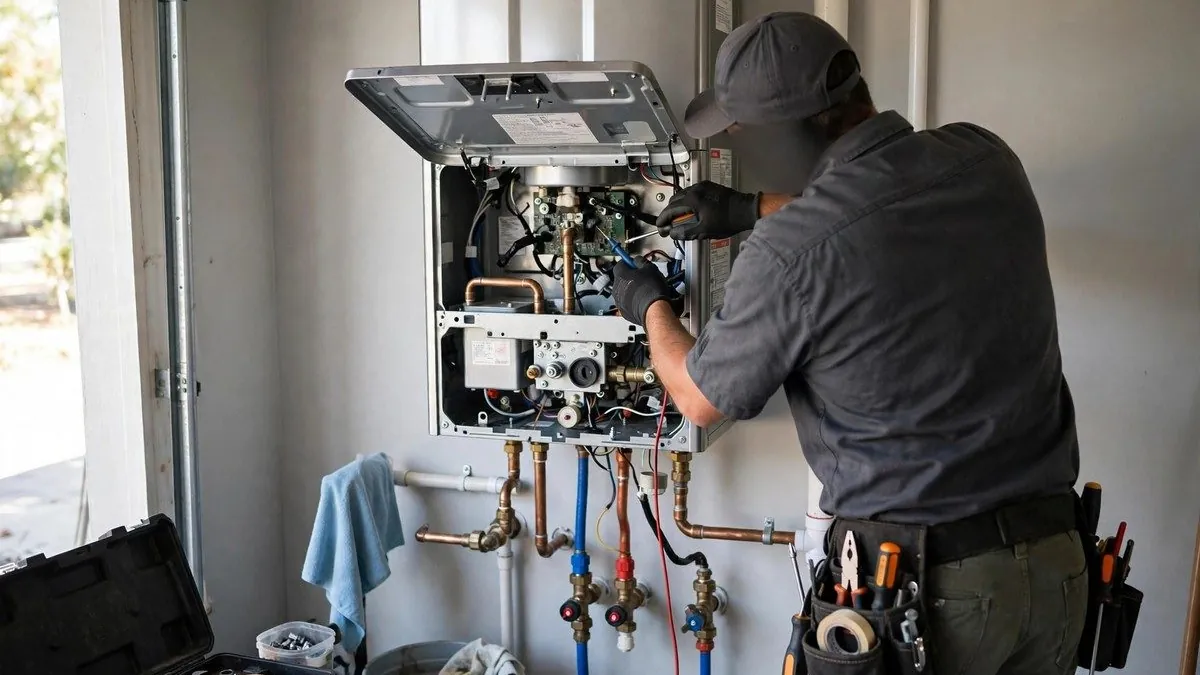
Is tankless the right choice for your household?
Tankless suits households that run out of hot water with a tank, or that want floor space back. It delivers hot water as long as the burner runs, so back to back showers are not a problem as long as the unit is sized for them.
It is a weaker fit when the gas line is small, the vent cannot be routed cleanly or the water is very hard and nobody will maintain the unit. If you are weighing it against a standard tank, our water heater installation page lays out the full range of unit types.
Why Ridgewood's hard water matters to a tankless unit
Ridgewood Water's 2019 data report listed hardness from 136 to 470 ppm as calcium carbonate. In grains per gallon, that is roughly 8 to 27 by our arithmetic, which is hard to very hard. The utility serves Ridgewood, Glen Rock, Midland Park and Wyckoff, so homeowners there face the same conditions.
A tankless heat exchanger has narrow passages, and scale builds in them quickly. Without periodic flushes, you can see temperature swings, reduced flow, noisy operation and eventually error codes that stop the unit.
The practical answer is a service schedule and, for many homes, a softener or scale inhibitor ahead of the heater. Check your manufacturer's maintenance guidance, because skipping scale control can affect the warranty.
What a tankless installation involves
- 1
Load and fuel check
We add up your fixtures, measure the gas line and meter capacity or confirm the electrical service, and size the unit to match.
- 2
Vent and location plan
Tankless units use dedicated venting, often through a sidewall. We map the route and the condensate drain for high efficiency models.
- 3
Removal and mounting
The old tank comes out, the new unit is wall mounted, and the water, gas and vent connections are made with isolation valves for future flushing.
- 4
Startup and setup
We purge air, test for leaks, set the temperature, confirm the flow and show you the controls and the service valves.
Want to know if your home can take a tankless unit?
Call and describe your gas line, your current heater and the vent path. We will give you a straight answer.
Tankless and tank heaters, side by side
Where tankless works well
- Continuous hot water for large families
- A wall unit that frees floor space
- Wide vent options on sidewall models
- Longer expected service life when maintained
Where a tank may be simpler
- Small gas line that would need upsizing
- Hard water with no plan for scale control
- Tight budgets for the initial install
- Homes where the old flue can be reused
| Item | Why it matters | What we check |
|---|---|---|
| Gas line size | Tankless burners draw a lot of gas at once | Pipe diameter, run length and meter capacity |
| Venting | Exhaust must be routed to code | Sidewall or roof path and clearances |
| Water quality | Scale limits heat exchanger life | Hardness, filtration and softener options |
| Condensate | High efficiency units produce acidic drain water | Nearby drain or neutralizer |
Descaling flushes and error codes
A flush circulates a mild descaling solution through the heat exchanger using the service valves, then rinses the unit clean. It is routine maintenance, and a good time to clean the inlet filter screen.
When a tankless heater shows a code, the cause is often scale, a blocked vent, low gas pressure or a flow sensor problem. We read the code, check the likely cause and fix it. If the unit is leaking or has stopped heating entirely, see our water heater repair page, and if it is beyond saving, water heater replacement.
What drives the cost of a tankless job
Pricing factors
A tankless quote is more variable than a tank swap. Here is what shapes it.
Call us and we will explain which of these apply to your house.
Replacing a heater with a new one of like capacity is minor work in New Jersey. The enforcing agency still has to be notified, a permit application filed within five business days and an inspection completed. Switching from a tank to a tankless unit often changes the gas line and vent, so we verify the permit category before we start.
Ready to talk tankless?
Call and tell us about your home. We will walk through sizing, venting and water quality with you.
Tankless water heater questions answered
Many manufacturers suggest roughly once a year, and more often in hard water areas. Ridgewood Water's reported hardness reaches the high end of the scale, so yearly service is a sensible minimum. Check your model's manual too.
They do not store water, so they do not drain the way a tank does. But each unit has a maximum flow rate, and running too many fixtures at once can still exceed it. Sizing to your actual use matters.
Sometimes. Many tankless units need more gas volume than a tank, so we measure the pipe and meter capacity. If the line is undersized, it has to be upsized.
Yes. It usually involves new venting, a gas line check, isolation valves and possibly a drain for condensate. We assess the old vent too, since it may serve other appliances.
Common causes are scale, restricted venting, gas supply problems and flow sensor faults. The code points to the system, then we confirm the cause on site.
Not always, but with Ridgewood's reported hardness range it is worth considering. At minimum, plan on regular flushes.