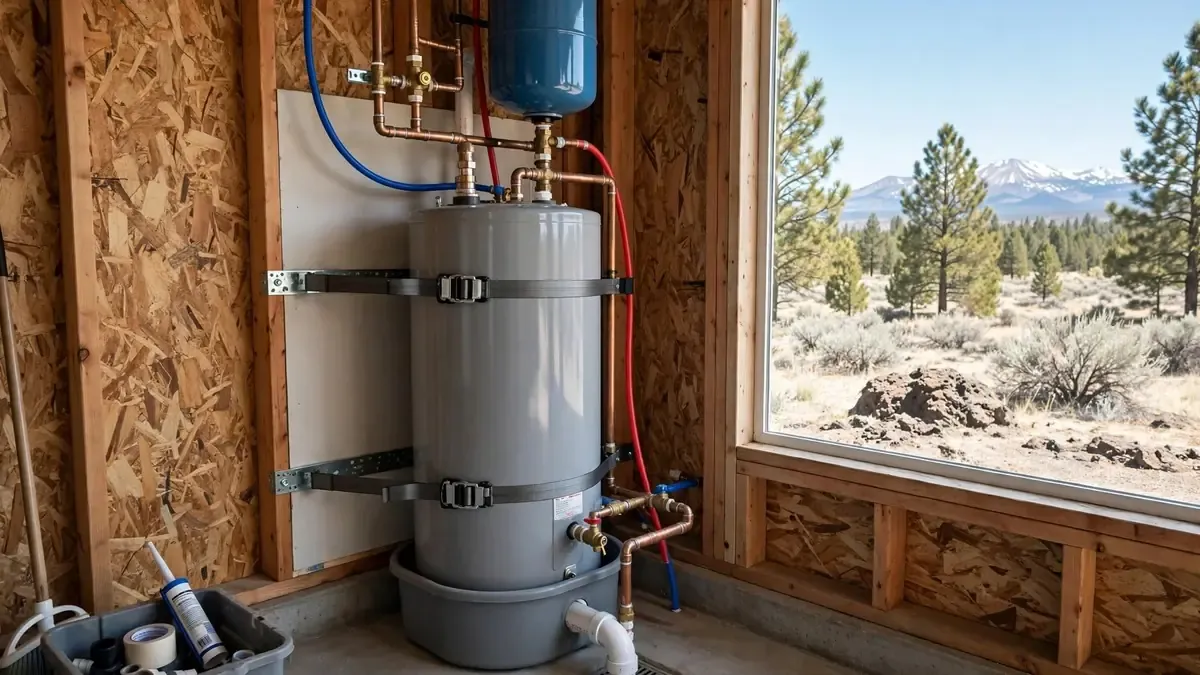
Planning an installation instead of waiting for a failure
A planned install beats an emergency swap. You pick the model and the day. If your current tank is leaking or has stopped heating, that is a different job, and our water heater replacement page covers it.
Installs usually fall into a few situations. New construction needs a heater roughed in from nothing. Renovations often move it to a new closet. Fuel switches, such as gas to electric, change the supply and venting entirely.
Tank, heat pump or tankless: picking the unit
The right heater depends on how many people use hot water, how much room you have and what fuel reaches the house. There is no single best choice, only the best fit for your layout and habits.
A conventional tank is the simplest and the easiest to service. A heat pump unit pulls heat from the surrounding air, so it needs clear space and a spot that tolerates a little cooling and condensate. A tankless unit saves floor area but asks more of the gas line, the vent and the water quality. We cover that option in detail on our tankless water heater page.
A tank-style heater suits you if
- You want the lowest equipment cost and the simplest service
- Your gas or electric supply and flue are already in good shape
- You have floor space and a floor drain or pan nearby
- Several fixtures often run at once for a short time
Consider a different type if
- You want to reclaim closet space (tankless)
- You want lower running costs and have open, ventilated space (heat pump)
- You are leaving gas behind and have spare panel capacity
- The old flue is shared, oversized or in poor condition
Venting, gas and electric: the details that decide the job
Most surprises on an install live in the supply and the vent, not the heater. A gas unit needs the right pipe size, a shutoff, a sediment trap and a vent that draws properly. An older chimney that once served a furnace and heater together may be too large for the heater alone once the furnace is replaced.
Electric and heat pump models need the right breaker, wire gauge and a clear path for the condensate or the relief valve discharge. Every storage heater also needs a temperature and pressure relief valve piped to a safe termination, and many homes need an expansion tank as well. We check all of this before we quote, so the price reflects the real job.
Want to talk through a planned install?
Describe your setup and what you are trying to change. We will tell you what the job involves before you commit.
Permits and inspection for a Ridgewood installation
According to New Jersey's Uniform Construction Code (N.J.A.C. 5:23-2.17A), replacing a water heater with one of like capacity counts as minor work. That means a permit is not required before the work starts, but the owner or contractor must notify the local enforcing agency first, file the permit application within five business days and pay the fee. Ridgewood's Department of Building and Inspections is that agency, and it includes a Plumbing Subcode Official.
An inspection follows, and the agency inspects within three business days of the request. A change in fuel, a new location or a bigger system is different from a like-for-like swap, so we confirm the category before work begins. New Jersey allows plumbing only by a master plumber or an authorized plumbing contractor, so ask any installer for their license.
How an installation day runs
- 1
Walkthrough and plan
We look at the location, the fuel, the vent path and the water and drain connections, then confirm the unit and the scope with you.
- 2
Notice and preparation
We notify the enforcing agency as required, gather the heater, valves, connectors and venting parts, and set a day.
- 3
Set, connect and vent
The old unit comes out if there is one. The new heater is set on a pan, piped, wired or gas-connected, vented and fitted with its relief valve.
- 4
Fill, test and walk you through
We purge air, check every joint and the gas connection, confirm ignition or heating, and show you the shutoffs and settings.
What moves the price of an installation
Factors that shape your quote
We give a clear price before work starts. These are the things that decide where it lands.
Call and describe your setup, and we will explain which of these apply to you.
Hard water and what it means for your new heater
Ridgewood Water's 2019 data report listed hardness between 136 and 470 ppm as calcium carbonate, which is hard to very hard depending on where your water enters the system. Ridgewood Water serves Ridgewood, Glen Rock, Midland Park and Wyckoff, so neighbors share the same utility.
Hard water leaves scale on heating elements and the bottom of a tank. Plan on periodic flushing and anode rod checks. If scale later shows up as noise or slow heating, our water heater repair team can sort it out.
Ready to plan your water heater installation?
Call and we will talk through the unit, the venting and the timing. Planned visits are scheduled around your day.
Water heater installation questions
Replacement usually means swapping a failed unit like for like, often in a hurry. Installation covers planned work, such as new construction, a relocation, a fuel switch or a type change, where the supply and venting may need to be built or altered first.
A like-capacity replacement is minor work under the state code. You do not need a permit before starting, but the enforcing agency must be notified, an application filed within five business days and an inspection completed. Bigger changes may need approval first, and we sort out which applies when we plan the job.
A straightforward swap is often a half day. A fuel switch, a new vent run or a relocated unit can take longer and sometimes a second visit for the electrician or gas work. We give you a realistic window when we book it.
They can lower running costs, but they need clear space, a condensate drain and a 240 volt circuit. They are a good fit for a roomy basement or utility area. We look at your space and tell you if it works.