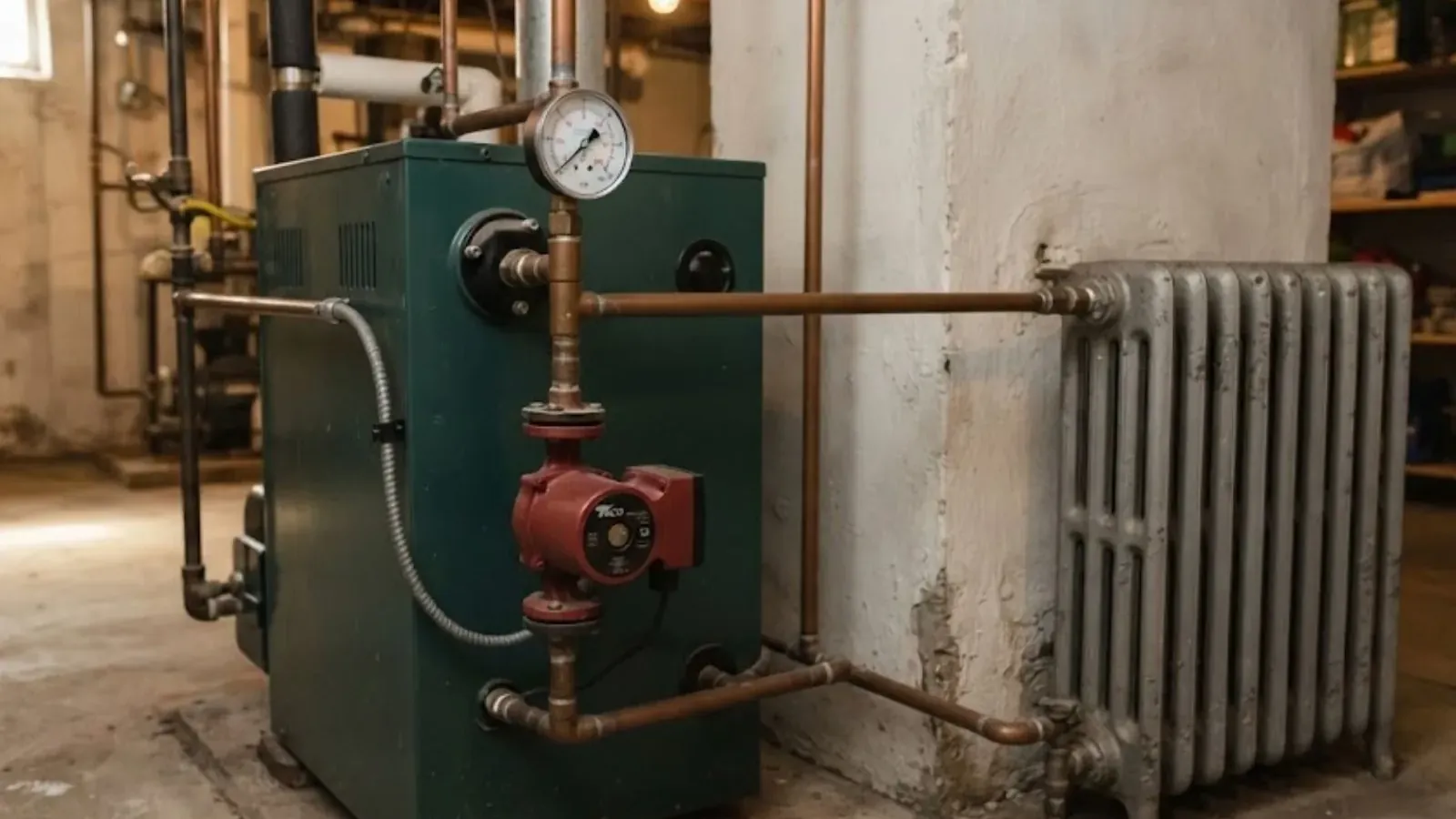
Safety comes before any repair
A boiler heats water, and in many homes it burns gas or oil to do it. That means it can produce carbon monoxide, leak fuel, and hold water at high temperature under pressure. None of those risks are visible, so safety checks come before troubleshooting.
Make sure your carbon monoxide alarms work before you touch anything. Place them on every level and near sleeping areas. If an alarm sounds, leave the house, call 911 and do not go back in to check the boiler.
Stop and call for help right away if you notice
The smell of gas or fuel oil near the boiler. Soot, scorch marks or a flame that rolls out of the burner area. Water pooling around the unit. A relief valve that is dripping steadily or discharging steam. A carbon monoxide alarm that has gone off. Shut off the fuel supply only if you can do it safely, and leave the house if you smell gas.
Start with the checks that cost nothing
Many service calls for no heat end with a simple cause. Before you assume the boiler has failed, work through the basics. They take a few minutes and do not require opening any panels.
- 1
Check the thermostat
Confirm it is set to heat, set above the room temperature, and has working batteries if it uses them.
- 2
Check power to the boiler
Most boilers have a service switch that looks like a light switch on or near the unit. Check the breaker as well.
- 3
Check the fuel
For oil, look at the tank gauge. For gas, confirm other gas appliances such as the stove are working.
- 4
Read the display
Many modern boilers show an error code. Write it down along with the model number from the label.
- 5
Check the pressure gauge
Most heating boilers sit in a stable pressure range stated in the manual. Pressure far below or above it tells a plumber a great deal.
Do not reset a boiler repeatedly. A lockout is a safety feature. If it trips more than once, there is a reason, and pressing the reset button over and over can flood a combustion chamber with unburned fuel.
Common boiler problems and what causes them
Boiler problems fall into a few families. The table below pairs the usual symptoms with their causes and shows who should handle each one.
| Symptom | Usual cause | Who handles it |
|---|---|---|
| No heat, no noise | Power, thermostat or fuel interruption | Homeowner checks first, then a pro |
| Cold radiators at the top | Trapped air in the system | Bleeding a radiator is a homeowner task, system purging is not |
| Pressure drops often | A small leak or a failing expansion tank | Plumber |
| Banging or kettle-like noise | Scale or sludge, or a pump problem | Boiler technician |
| Pilot or ignition fails | Dirty sensor, gas valve or ignition part | Licensed professional only |
| Hot water but no heat | Zone valve or circulator problem | Plumber or heating technician |
| Water around the base | Leaking fitting, tank or heat exchanger | Plumber right away |
A table like this helps you describe the problem on the phone, but it is not a substitute for a diagnosis. The same symptom can come from several causes, and the cheaper cause is not always the real one.
What a homeowner can safely do
The line between a homeowner task and a professional one is drawn by risk. If a task involves fuel, flame, pressure relief or sealed parts, it goes to a pro.
Reasonable for a careful homeowner
- Reset the thermostat and replace its batteries.
- Check the breaker and the service switch.
- Confirm there is fuel in the tank or gas at the stove.
- Bleed air from a radiator with a key, following the manual.
- Clear snow and debris from outdoor vents and intakes.
- Dust the radiators and clear furniture from the heat path.
Leave to a licensed professional
- Anything involving the gas valve, burner or ignition.
- Adjusting or replacing the pressure relief valve.
- Opening the combustion chamber or cleaning the heat exchanger.
- Adding or draining water in a system you do not understand.
- Replacing circulators, zone valves or the expansion tank.
- Diagnosing carbon monoxide or flue problems.
Why pressure and the relief valve matter
A boiler is a sealed vessel. The relief valve is the last line of defense if pressure or temperature goes too high. It should never be capped, plugged or adjusted by anyone but a trained technician. If the valve is dripping, that is a symptom of something else, usually an expansion tank that has lost its air cushion.
Low pressure causes a different set of problems. Radiators cool, the burner short cycles, and the fill valve may be adding water that hides a slow leak. A plumber who finds low pressure traces the leak first, because topping up the water treats the symptom.
Leaks around the boiler deserve a closer look
Small drips at a valve packing or a threaded fitting are common. They often mean a nut needs attention, but they also raise the humidity around the burner and rust the cabinet. Larger or hidden leaks can come from the heat exchanger or from piping behind a wall.
If the fill valve keeps adding water, the system is losing water somewhere. Our leak detection service traces those losses when the leak is not visible.
Boiler down and the house is cold?
Call (973) 488-5410 and describe the symptoms. A plumber will tell you what is safe to check while you wait.
Repair or replace: how to think about it
Boilers last for many years, but not forever. A repair makes sense when the failed part is isolated and the rest of the system is in decent shape. Replacement starts to make sense when repairs repeat, parts are hard to find, or the heat exchanger itself has failed.
Ask the technician which part failed, why it failed and what else is likely to follow. Also ask whether the boiler is sized for your house. An oversized boiler cycles on and off, wastes fuel and wears out sooner.
Some homes pair a boiler with an indirect water heater that makes hot water from the same fuel. If that part fails, a water heater replacement may be needed even if the boiler is fine. Ask about it if you lose only hot water.
Licensing in Ridgewood and New Jersey
The New Jersey Division of Consumer Affairs states that plumbing work may only be performed by a master plumber, an authorized plumbing contractor, or employees working under one. The state also runs an online license verification portal where you can look up a business or a person before you hire.
Not every boiler task falls under the plumbing license, so ask any company which license covers the work they propose and look it up. Use this step before you approve piping, gas or combustion work in your home. A reputable company will give you the license information without hesitation.
Source type: NJ Division of Consumer Affairs, State Board of Examiners of Master Plumbers (state agency)
What affects the price of boiler repair
Boiler repair prices range widely because the failures range widely. Here is what a plumber weighs when giving you a number.
Factors that move the price
Boiler repairs vary a great deal. The listed items are what a plumber weighs when giving you a price.
You get a clear price before work starts.
Before you approve a larger repair, check that the license is current. According to the State Board of Examiners of Master Plumbers, licenses renew every two years, so use the state's verification portal to confirm the license is active today.
Helping your boiler last through the winter
Annual service by a qualified technician catches small problems before they stop the heat. Keep the area around the boiler clear, never store paint or cleaners near it, and listen for changes in sound. A boiler that sounds different is trying to tell you something.
If you live in Waldwick or Wyckoff, the same approach works there. Our boiler repair team covers both towns, along with Ridgewood.
Need a boiler checked?
Call (973) 488-5410 and describe the symptoms.
Questions homeowners ask
You can handle the basic checks, such as the thermostat, the breaker, the fuel level and bleeding a radiator. Anything involving gas, burners, relief valves or combustion belongs to a licensed professional.
The usual causes are a small leak in the system or an expansion tank that has failed. Topping up the water does not fix either one, so a plumber should trace where the water is going.
Often it is scale or sludge, or a circulator problem. It can also be trapped air. A technician can tell which by listening and testing.
The New Jersey Division of Consumer Affairs runs an online license verification portal. Ask the company which license covers the work and look it up before you agree to anything.
Leave the house first. Do not use switches or phones inside. Call 911 and the gas utility from outside.