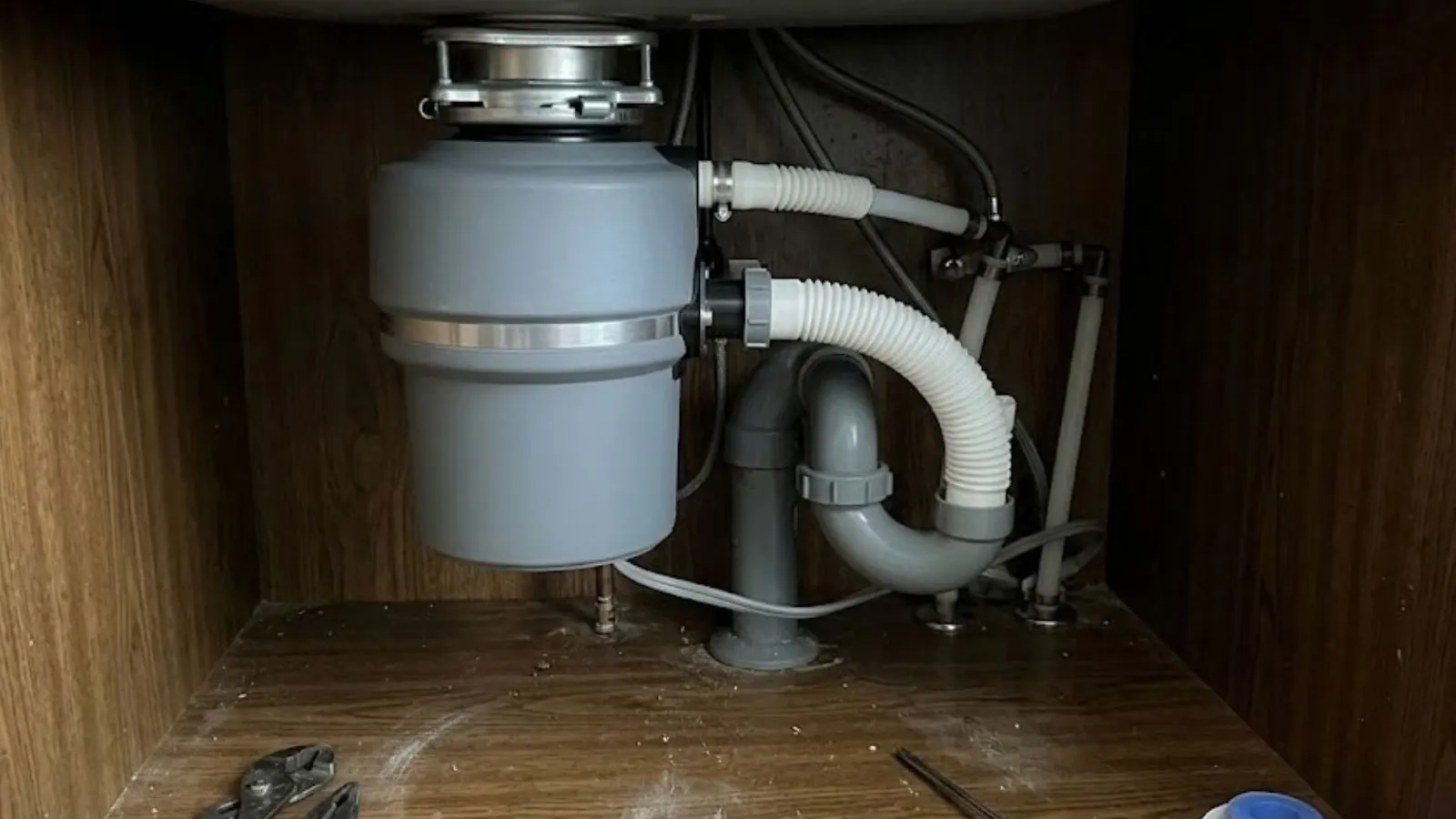
Reading what your disposal is telling you
A disposal usually announces a problem before it quits. The sound it makes, and what the sink does, narrows the cause quickly.
These patterns come up on most calls.
Hums but does not spin
The impeller is jammed by a bone, utensil or hard seed. A hex key at the bottom turns the motor by hand to free it.
Silent and dead
A tripped reset button on the bottom, a switch or outlet fault, or a burned-out motor.
Water at the bottom of the cabinet
A failed top seal, a cracked housing or a loose drain connection. Cabinet bases rot fast, so this one is urgent.
Sink backs up when it runs
The clog is past the disposal, in the trap or the kitchen branch line.
Runs but grinds poorly
Dull shredder ring, a worn motor or too much fibrous waste.
Before we arrive: make the sink safe
A jammed or leaking disposal needs two things right away, power off and water stopped.
Cut the power
Switch off the wall switch and unplug the unit under the sink. Never put your hand in the drain, even when it appears off.
Press the reset
Look for a small red button on the bottom of the disposal. If it popped, press it once after the unit has cooled.
Do not add water or chemicals
Skip drain cleaner. It sits in the sink and splashes anyone who then works on the pipe.
Shut off the sink
If the cabinet is wet, close both valves under the sink, and empty the cabinet so the wood can dry.
Repair steps from jam to leak
- 1
Verify power and reset
Switch, outlet and reset button are checked before we assume the motor failed.
- 2
Free the jam
The flywheel is turned by hand from below and any obstruction is pulled out with tongs, not fingers.
- 3
Find the leak path
Water is run through the sink, dishwasher and drain to see whether the leak is at the flange, the housing or the dishwasher inlet.
- 4
Repair or replace
Seals, gaskets and hoses are replaced. A cracked housing or seized motor is not repairable and the unit is replaced.
Disposal dead and the sink standing full?
Call (973) 488-5410. We will walk you through the reset and the shutoff while a visit is arranged.
What the disposal sends down the line in Ridgewood
The Village of Ridgewood operates its own Water Pollution Control Facility, so what goes down your kitchen drain ends up in a locally run system. Before it gets there, it has to pass through your trap, your branch line and your house sewer.
Grease is the usual culprit. It leaves the disposal as a warm liquid, cools in the pipe and builds a ring that gets thicker with every dish. Coffee grounds, rice and potato peels pack together instead of washing through.
If a kitchen drain keeps slowing after you clear the disposal, the blockage has moved down the line. That is drain cleaning territory, and a main line problem would need sewer line cleaning.
Repair or replace the disposal
Repair is reasonable when
- The unit hums or jams but the motor runs free by hand
- A hose, gasket or flange seal is leaking
- It is newer and the grind is still good
- The reset button restores power
Replace when
- The housing is cracked or rusted through
- The motor is seized or burned out
- It leaks from the body and not the seals
- Repairs would cost near the price of a new unit
A new disposal also has to match the sink flange and the drain layout. If you are adding a disposal where none exists, an electrician or an outlet under the sink may be needed. We confirm that on the phone so there are no surprises on the day.
If water is coming from the faucet side of the sink and not the drain, see faucet repair. Homeowners in Waldwick can check the Waldwick page for nearby coverage.
What affects the price of disposal work
A reset is a short job and a full replacement is not. You get a clear price before work starts.
We confirm the scope on the phone and again at the sink before starting.
Disposal jammed, leaking or dead?
Call (973) 488-5410. Any hour, any day.
Disposal questions homeowners ask
Probably jammed, not broken. Turn it off, then use a hex key in the bottom socket to rotate the flywheel back and forth.
It is a small red button on the underside of the unit. If it has popped out, push it in once the motor has cooled.
Grease, coffee grounds in volume, bones, fibrous vegetables like celery and corn husks, and pasta or rice that swells.
The drain behind the disposal is partly blocked. The water has nowhere to go, and the clog is further down the line.
Usually yes. Most disposals use a standard mounting ring, and we match the new unit to your flange.
Yes. A slow leak soaks the cabinet floor and can reach flooring and walls. Close the shutoffs and call.
Yes. It needs power, a drain connection and sink flange compatibility, which we check beforehand.