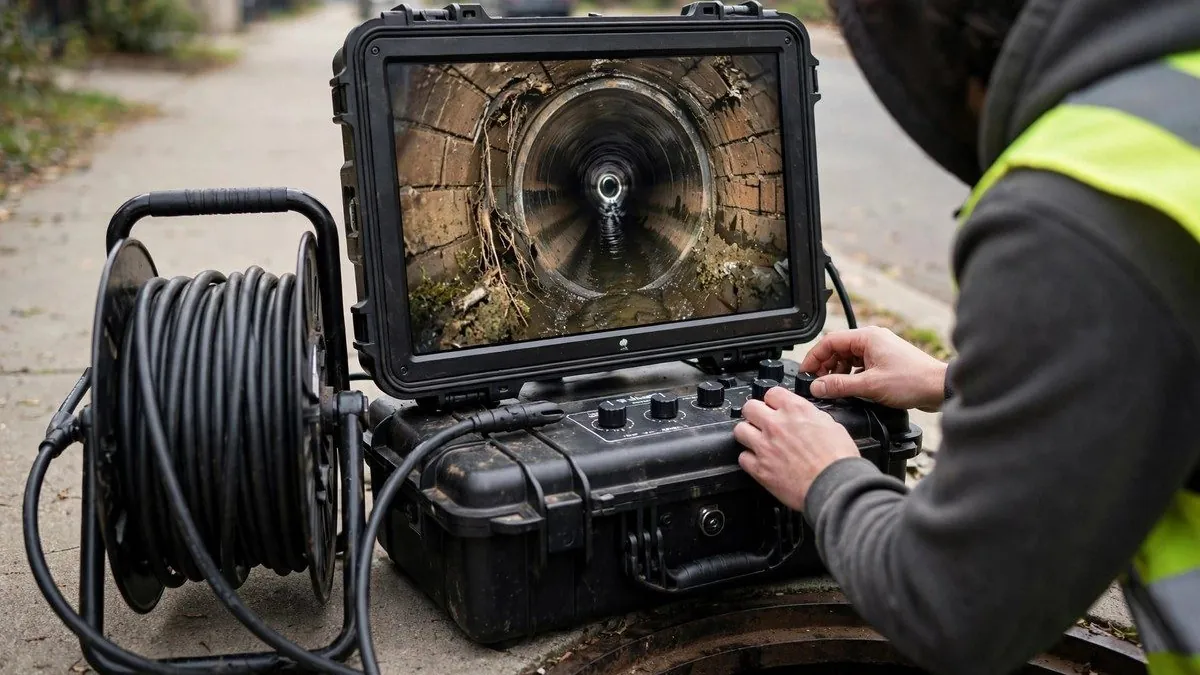
What a sewer camera inspection actually shows
A technician feeds a waterproof camera on a flexible rod into your sewer line, usually through a cleanout. The camera sends live video to a monitor, and many systems also track the distance traveled and the position of the camera underground.
You see the pipe material, the joints, the slope, and anything that does not belong. That includes roots, cracks, offset joints, grease, scale and sections where the pipe has collapsed or sagged.
Root intrusion
Fine roots enter at joints and cracks, then grow into a mass that catches paper and waste. The video shows where and how heavy.
Cracks and breaks
Clay and cast iron can crack with age and ground movement. A camera finds the exact distance from the cleanout.
Bellies and sags
A low spot holds water and waste, and it causes repeat clogs even after cleaning. The camera shows standing water along the run.
Offsets and separations
Joints that have shifted let soil and roots in. These appear as a step or gap between pipe sections.
Why homeowners order an inspection
Some people call after a backup, and others schedule an inspection as part of a planned decision. Both are good reasons, and the second is often cheaper in the long run.
- Before buying a home, especially one with mature trees or older piping
- After repeated clogs in the main line or a slow drain throughout the house
- Before a basement renovation, an addition or a bathroom move that adds load to the line
- When a sewer smell appears in the yard or basement
- After a cleaning, to confirm that the line is clear and the pipe is sound
- Before relining or repair, so the contractor knows exactly what to fix
The factors that set the price
What moves the cost of a CCTV sewer inspection
Prices vary by company, but these are the items that change a quote from one house to the next.
Ask whether cleaning, locating and the written report are included, since those are the usual add-ons.
Want the sewer line checked before you decide?
A camera inspection can answer whether you need cleaning, a spot repair or a full replacement.
Basic scan, scan with locating, and scan with cleaning
| Package | What is included | Best for |
|---|---|---|
| Basic camera scan | Video of the line from the cleanout, with a verbal summary | A quick check on a line that is flowing |
| Scan with locating | Camera plus a surface mark where a defect sits, with depth | Planning a spot repair or excavation |
| Cleaning plus camera | The line is cabled or jetted first, then scanned | Lines that are blocked or slow |
| Full written report | Video files, marked locations and photos with notes | Home buyers, insurance claims, repair bids |
If a blockage shows up, the plumber may recommend drain cleaning before or after the inspection. A cleaned line gives a clearer picture, and the video then shows whether the cleaning exposed damage.
What Ridgewood's code says about house sewers
Ridgewood's Village Code, Chapter 238, sets material rules for house sewers. It lists cast iron or vitrified clay for sewers beyond three feet from the building, and says sewers must be laid deep enough to be protected from frost.
That matters when you read your video. Cast iron scales and clay cracks and takes in roots at the joints, and those are exactly the conditions a camera picks up in older lines.
Source type: Village of Ridgewood municipal code, Chapter 238 Article II (published on ecode360)
Reading the results
Ask the technician to explain the video as it plays. A good one points out the pipe material, the joints and each defect, and tells you how far from the cleanout it sits.
Not every defect needs a repair. A single hairline crack with no roots may only need monitoring, while a collapsed section needs work soon. Ask for the plumber's honest ranking, from urgent to watch.
- 1
Confirm the pipe material
Cast iron, clay, plastic or Orangeburg all fail in different ways, and the repair choice depends on it.
- 2
Note the distance to each defect
The position from the cleanout lets a crew find the spot without guesswork.
- 3
Ask about severity
Minor roots, a belly or a break are not the same, and the plumber should rank them.
- 4
Request the video file
Keep a copy for your records, and share it with other contractors if you want a second opinion.
What happens after the inspection
If the line is sound, you leave with confidence and a baseline recording for the future. If it is not, the video lets you compare repair options based on the same facts.
Spot repairs, pipe lining and full replacement all depend on where and how the pipe has failed. Our sewer line repair page explains those choices, and the camera record is what makes a fair bid possible.
How the equipment works, and why it matters to the quote
Push cameras are built for house laterals. They use a flexible rod with a sealed lens and lights, and they can bend through cleanout fittings and long runs. A good unit records video and shows footage counters, so each defect has a measured position.
Cheaper or older gear produces fuzzy video and no distance data. That is not a deal breaker for a quick look, but it limits what a repair crew can do with it. When you book, ask about the recording and whether you receive a copy of the file. Our sewer camera inspection page explains what a standard visit covers.
Inspecting before you buy a home
A general home inspection does not look inside the sewer line. For an older house, or any lot with large trees near the lateral, a camera inspection is a practical addition to the purchase process.
Schedule it during the inspection period so you can still negotiate. A defect found after closing becomes your repair, but one found before can change the price or lead to a seller credit.
Mistakes that make an inspection less useful
- Hiring someone who cannot show you the video live or deliver a copy
- Skipping cleaning on a line that is partly blocked, so the camera cannot pass
- Not asking where the pipe changes material, which is often where trouble starts
- Accepting a verbal diagnosis with no distance or location marked
- Treating the inspection as the repair, when it is only the first step
We also work with homeowners in Waldwick and Glen Rock on the same inspections, and the factors above apply the same way there. A short call usually tells us which package fits.
Ready to see what is inside your sewer line?
Call and describe your symptoms. A plumber can explain what the inspection will cover.
Sewer camera inspection questions
A routine inspection often takes under an hour once the cleanout is open. Longer lines, blocked pipes or locating work can extend the visit.
A cleanout makes it much easier. Without one, the plumber may need to pull a toilet or use another access point, which adds time and can affect the price.
Yes. Roots are easy to spot on video, and the technician can note where they enter and how dense they are.
Ridgewood's code names cast iron and vitrified clay for house sewers beyond three feet from the building, so older lines in town may be those materials. Expect the video to show scale in iron and joint cracks or roots in clay.
Often yes before a purchase or major renovation. A line can look fine at the sink and still hold roots, a sag or a hairline crack that will cause trouble later.