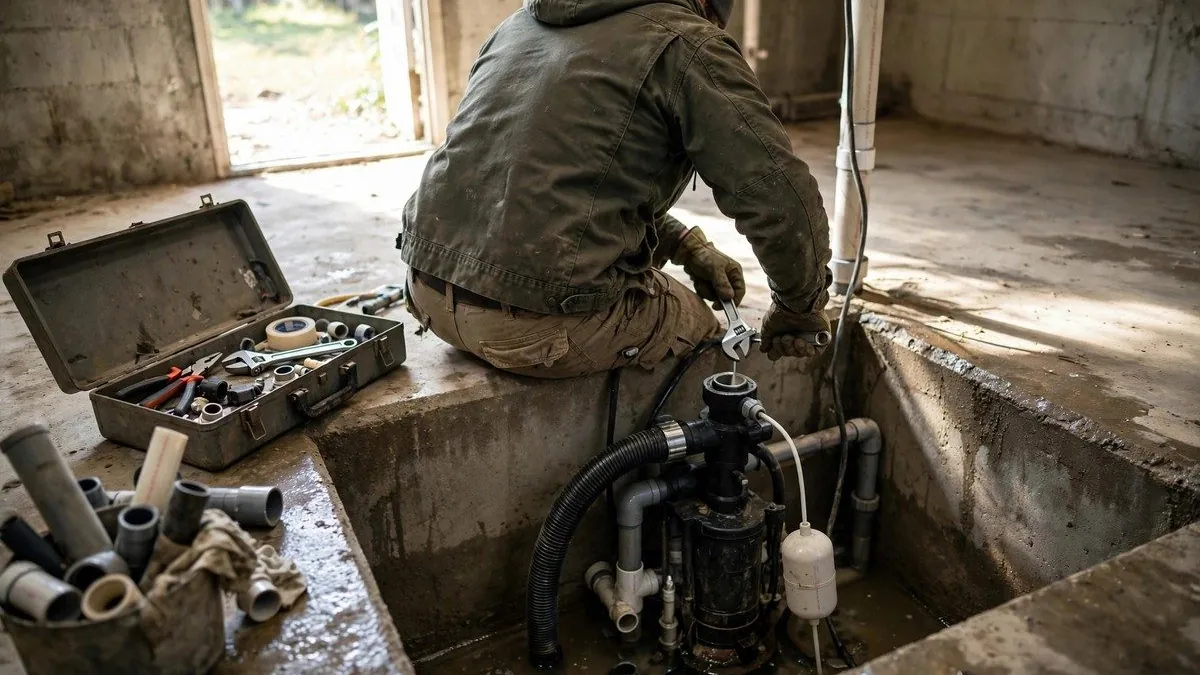
Why sump pumps fail when you need them most
Sump pumps sit idle most of the year, then work hardest in the worst weather. The parts that wear while idle, the float switch, the check valve and the impeller, are the ones that fail first.
These failures are the ones we see most often.
- The float is stuck against the pit wall or snagged on the power cord, so the pump never gets the signal to start.
- The pump runs but moves no water because the impeller is clogged with grit or the discharge line is frozen or blocked.
- The check valve has failed and water falls back into the pit, so the pump cycles every few seconds.
- The motor has burned out after years of heavy cycling.
- The outlet or breaker has tripped because the pump shares a circuit.
- The pit is undersized, so the pump short-cycles in heavy rain even when it works.
Before we arrive: pit full and water rising
The goal is to buy time and keep yourself safe. Skip anything involving standing water and electricity.
Check the power
Look at the breaker and the outlet. If the pump has a GFCI plug, press reset. Do not touch the plug with wet hands or while standing in water.
Lift the float gently
If you can reach the pit dry, lift the float by hand. If the pump starts, the float was stuck. If not, leave it and call.
Bail and divert
Use buckets or a wet-dry vacuum to move water out of the pit, and shift stored items off the floor.
Look outside
Confirm the discharge pipe outside the house is not blocked or frozen, and that the end sits clear of the foundation.
What we check and fix at the pit
- 1
Inspect power and float
Circuit, plug and float switch are tested first, since those cause most no-start calls.
- 2
Pull and clean the pump
The pump is lifted out, the intake screen and impeller are cleaned and the pit is flushed of sediment.
- 3
Test the check valve and discharge
Water is run into the pit to confirm the pump clears it and the valve holds without backflow.
- 4
Repair, replace or add a backup
Worn pumps are replaced, undersized pits are discussed and a battery backup can be added for power outages.
Pit full and the pump is silent?
Call (973) 488-5410. We answer around the clock, including during storms.
Ridgewood's sump discharge rules, and why they matter
According to Village Code Chapter 238, discharging stormwater, groundwater, roof, pool or sump water into the sanitary sewer is prohibited. The chapter sets out inspections, a monthly surcharge billed to the owner until a property complies, and a lien if the charge goes unpaid for 30 days. Reinstating an illicit connection after inspection carries fines.
The practical point is where your pump sends its water. The discharge must go outside the house and away from the sanitary sewer, not into a floor drain, a laundry tub or a drain tied to the house sewer.
If you are replacing a pump and the old discharge was ever plumbed to a drain, tell us. We will route the new pipe correctly and not repeat the problem.
A creek-lined town and the water table
Ridgewood is in the National Flood Insurance Program, and Village Code Chapter 154 names the Saddle River, Ho-Ho-Kus Brook, Goffle Brook, Diamond Brook and Mannings Brook as waters studied for flooding. The remnants of Hurricane Ida on September 1, 2021 brought heavy rain and damage to parts of town.
A sump pump will not stop a flood, and it is not designed to. It handles groundwater that rises under a basement slab after long rain. For that, a battery backup is the difference between a dry basement and a power outage that coincides with the storm.
If your basement stays wet even with a good pump, the answer may be a drainage system and not a bigger pump. Our basement waterproofing service covers interior drains and pit upgrades.
A pump failure that coincides with a plumbing leak can be hard to tell apart in a wet basement. Our leak detection service helps sort groundwater from a pipe leak. Neighbors in Fair Lawn can find nearby coverage on the Fair Lawn page.
What goes into a sump pump price
Fixing a float is a small job and a new pit is not. You get a clear price before work starts.
We explain the options on site and agree on the work before it begins.
Basement taking on water?
Call (973) 488-5410. We answer 24/7, including during storms.
Sump pump questions
It depends on how often the pump runs. Pumps that cycle constantly wear out sooner, and age plus a recent storm failure is a good reason to replace.
A failed check valve, a stuck float or a high water table can keep it cycling. We find out which before replacing anything.
If your basement has flooded or the power goes out in storms, yes. A backup runs the pump when the main power fails.
Outside, away from the foundation, and never into a sanitary sewer drain. Village code prohibits the sewer connection.
Pour a bucket of water into the pit and watch the float rise and the pump start. If it does not, call before the next storm.
No. A pump removes water that reaches the pit. Waterproofing stops or redirects water before it enters the basement.
Yes. We cover Ridgewood and nearby Bergen County towns. Call with the address.