Clues that you may have a leak
Start by looking at what you have noticed. A single clue is easy to explain away. Two or three together are hard to ignore.
- A water bill that rises with no change in how many people live in the house or how much laundry you do.
- A sound of running water when everything is off.
- Damp spots, stains, bubbling paint or peeling wallpaper on walls and ceilings.
- Warm patches on a floor, which can point to a hot water line under a slab.
- Mold or a musty smell in a closet, basement or under a cabinet.
- Low water pressure that appeared without a clear cause.
- Wet or unusually green grass between the street and the house.
The meter test: is water leaving the house?
The meter is the fastest way to find out whether you have a leak. It measures everything that passes through the service line, so it shows leaks inside and outside the house.
- 1
Turn off every fixture
Stop the washer, dishwasher, ice maker, humidifier and irrigation. Make sure no one flushes a toilet.
- 2
Find the meter and read it
Open the meter lid. Note the numbers, or watch the small low-flow indicator, often a dial or a triangle.
- 3
Wait without using water
Wait fifteen to thirty minutes. For a slow leak, wait two hours and keep every tap closed.
- 4
Read it again
If the numbers moved or the indicator is spinning, water is leaving the pipes.
What the result tells you
If the meter does not move, the house is tight and the problem may be a fixture that only leaks when used, or a billing issue. If the meter moves, close the main shutoff inside the house and check again. If it stops, the leak is inside. If it keeps moving, the leak is between the meter and the house shutoff.
Check the usual suspects inside
Before you suspect a pipe in a wall, rule out the fixtures. Toilets, faucets and water heaters cause more hidden water loss than broken pipes.
Toilets
A leaking flapper is the most common source of unseen water loss. Put a few drops of food coloring into the tank and wait twenty minutes without flushing. If color appears in the bowl, the flapper or fill valve is leaking. This can waste a large amount of water while making almost no noise.
Faucets, shutoffs and hoses
Open the cabinets under sinks and run a dry paper towel along the supply lines and shutoff valves. Look at washing machine hoses, ice maker lines and the dishwasher supply. Hoses fail slowly and then all at once, so replace aged hoses before they do.
The water heater and boiler
Check around the base of the tank and the relief valve discharge pipe. A weeping valve or a rusted fitting can drip for weeks. If you see water at the base of the tank itself, the tank may be failing and you should treat it as urgent.
Look for hidden leaks room by room
Walk through the house and match what you see to the likely source. The table below pairs common signs with the first thing to check.
| Where you notice it | Possible source | What to try |
|---|---|---|
| Ceiling stain below a bathroom | Tub or shower drain, supply line, or shower pan | Check caulk and grout upstairs, run the shower and watch |
| Wall bubbling near a kitchen sink | Supply line or drain connection | Open the cabinet and check, then feel the wall |
| Basement wall damp in one patch | Pipe in the wall, or groundwater | Compare after dry days and after rain |
| Warm floor spot | Hot water line under the slab | Call for leak detection equipment |
| Musty closet near the water heater | Slow connection leak | Inspect fittings and look behind the unit |
A moisture stain that appears after rain suggests a roof or window problem, not a pipe. A stain that grows on dry days, or that spreads when a particular fixture is used, points to a pipe or a drain.
Meter moving and you cannot find the leak?
Call (973) 488-5410. A plumber can trace the leak with detection equipment instead of opening walls.
Outside the house
Walk the property. Look for soft, wet ground, a spot where the grass is greener or sunk, and water seeping at the foundation. Check outdoor spigots for drips and make sure hoses are not left connected in cold weather, since a frozen hose bib can split inside the wall.
If you have an irrigation system, shut it off and repeat the meter test. A stuck valve or a broken head can leak without any surface sign.
Frost matters for buried lines. According to the frost depth table in New Jersey's construction code, northern New Jersey uses three feet, so a line laid shallower than that can freeze and split in a hard winter. A wet patch in January deserves a quick look.
Who owns the water line to your Ridgewood house
Ridgewood Water is the village's utility, and its customer line is 201-670-5520. In its lead service line program, Ridgewood Water states that the public side of a service line, from the main to the curb, is owned by the utility, while the private side, from the curb to the building, belongs to the homeowner.
That split matters for leaks. If your meter test shows loss between the meter and the house, the repair is generally on you. If water is surfacing near the curb or the street, contact Ridgewood Water first and describe where you see it.
Source type: Ridgewood Water lead service line program notices (municipal utility) and NJ Infrastructure Bank release (state agency)
What a leak detection visit adds
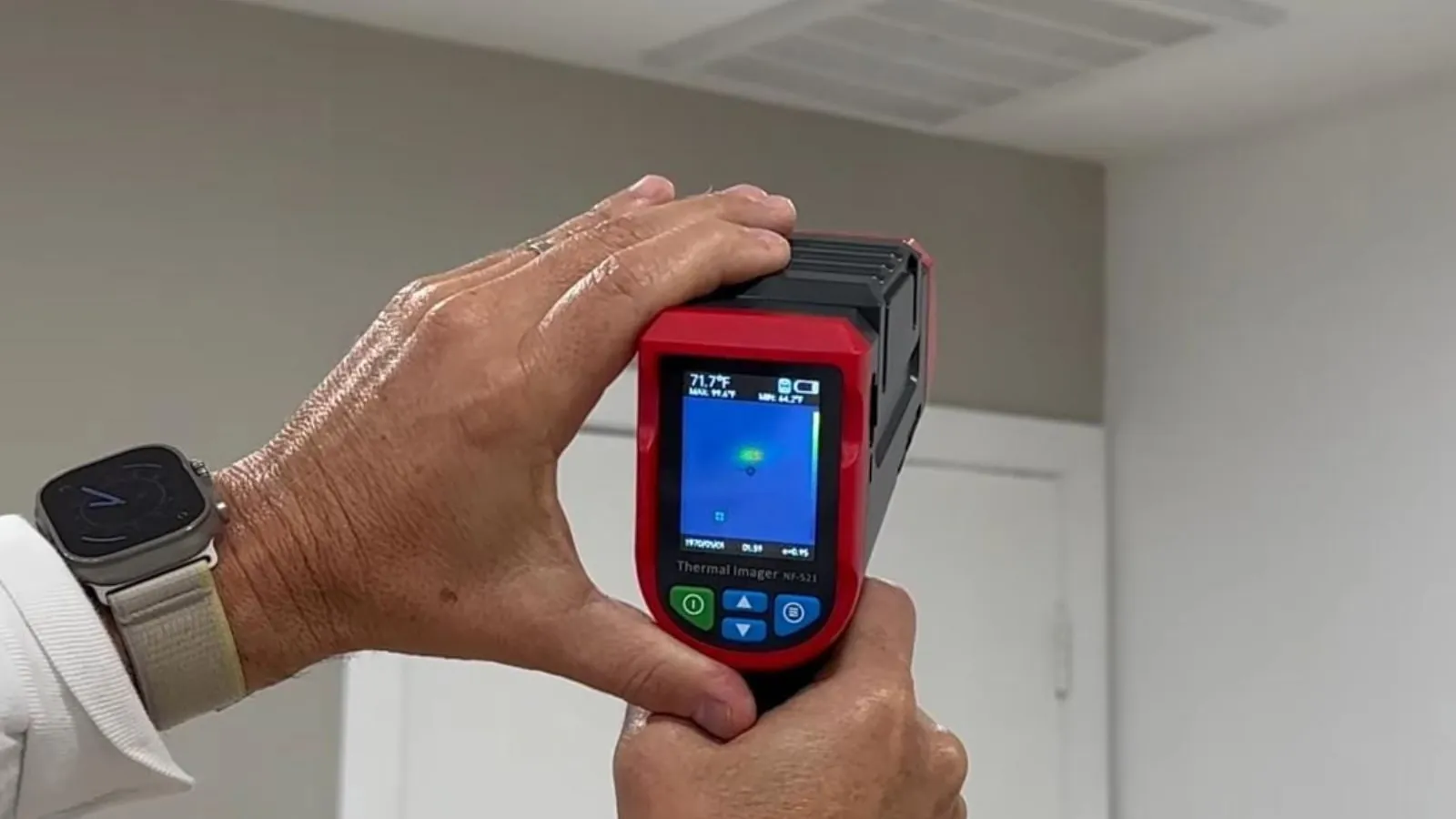
When the meter says there is a leak and your checks find nothing, equipment is the next step. A leak detection visit uses acoustic listening devices, moisture meters and thermal imaging to locate the leak before anything is opened. The goal is a small, accurate opening instead of guessing.
That saves drywall, flooring and time. It also gives you a clear answer about whether the leak is in a fixture, a wall, a slab or the buried line.
What to do when you find the leak
Act in this order. The first goal is to stop the water, the second is to keep people safe, and the third is to document the damage.
- Shut off the water to the fixture. If you cannot, close the main inside the house.
- Turn off power to the area if water is near outlets, a panel or appliances, and do it from a dry spot.
- Take photos and write down when you first saw the damage. They will help with an insurance claim.
- Dry the area. Fans and open windows slow mold growth.
- Call a plumber for pipe repair. A split pipe is a case for burst pipe repair, and a failed line from the street belongs with water service line repair.
What affects the cost of finding a leak
No one can price a leak before knowing where it is. What can be said in advance is which factors push the cost up or down.
Cost drivers for leak detection and repair
The cost of finding and fixing a leak depends on how hard it is to reach.
A clear price is given before work starts.
Nearby towns
The meter test works the same way in Wyckoff and Midland Park, although you should check with your own utility for the meter location and any local rules. We serve both towns, along with Ridgewood.
Think there is a leak?
Call (973) 488-5410 and describe what you found.
Questions homeowners ask
Run the meter test. Turn off all water use, note the meter reading, wait, and read it again. Movement means water is leaving the pipes.
Check toilets with food coloring, look at hoses and the water heater, and run the meter test. A quiet toilet leak or an underground line can run for weeks without a visible sign.
In Ridgewood Water's program, the utility owns the public side from the main to the curb and the homeowner owns the private side from the curb to the building. Contact Ridgewood Water at 201-670-5520 if you are unsure.
Often yes. Plumbers use acoustic listening tools, moisture meters and thermal imaging to find the spot, so only a small opening is needed.
If you cannot stop the leak at a fixture shutoff, yes. Close the main shutoff inside the house, then call a plumber.