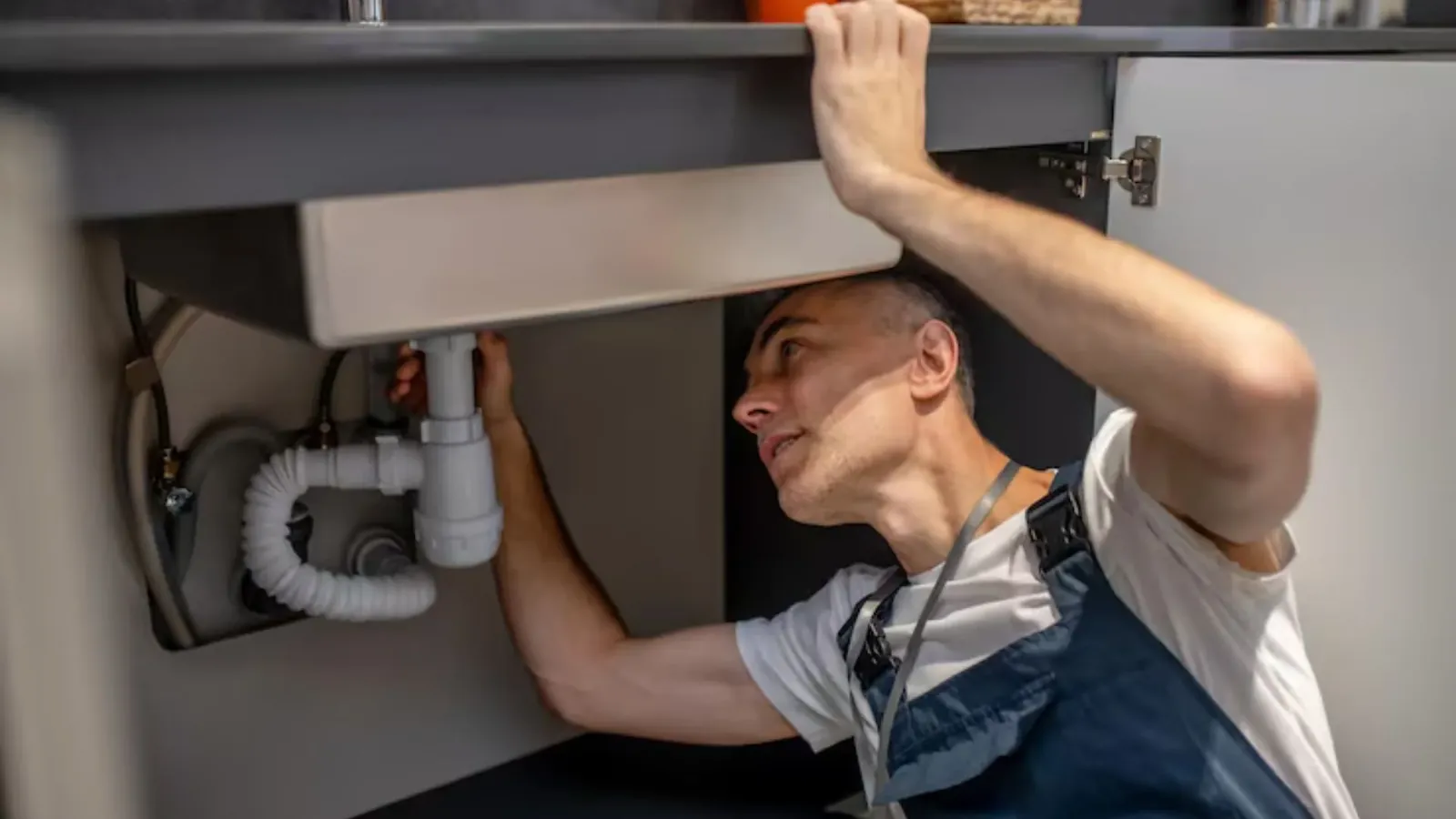
What "no clog" usually means
When people say there is no clog, they usually mean there is nothing visible and nothing that came up on a plunger or a bent wire. That rules out the top few inches of the drain. It does not rule out a coating inside the pipe, a partial blockage further along, or an air problem that makes water move slowly.
Water leaves a sink by gravity. It needs a pipe with a smooth bore, a steady downward pitch, and air coming in behind it so it does not gulp and stall. If any one of those three is off, the sink drains badly even though no single lump is blocking it.
That is why the fix often looks different from a normal clog. A longer plunger stroke will not help a vent problem, and a chemical product will not fix a pipe that has lost its pitch. The goal of the next sections is to sort out which of these you actually have.
Check the parts you can see first
Start with the simplest items because they are the most common and the cheapest to rule out. Many sinks that seem to have no clog are held up by something sitting right at the opening or in the first few inches below it.
- 1
Clean the stopper and strainer
Lift out the pop-up stopper or basket strainer and wipe away the slime that wraps the stem. A thin film here can slow flow more than you would expect.
- 2
Open and empty the trap
Place a bucket under the curved trap, loosen the slip nuts by hand, and rinse the trap out. Look inside the short pipe running to the wall as well.
- 3
Run water and watch the wall pipe
Reassemble, then run the tap for a full minute. If water backs up quickly at the wall, the restriction is beyond the trap.
- 4
Remove the faucet aerator
If the sink fills slowly rather than drains slowly, the aerator may be packed with mineral grit. Unscrew it and rinse it clean.
Do these in order and stop when the water moves normally again. If you finish all four and the sink is still slow, you have learned something useful. The problem is past the parts a homeowner can reach without tools.
Vent trouble: the cause most people never suspect
Every drain fixture needs a vent, which is a pipe that rises through the wall and out the roof. It lets air in behind the water so the flow stays smooth. A blocked vent acts like a finger over the top of a drinking straw. The water hangs back, then rushes out with a gurgle.
Signs of a vent problem include gurgling from the sink or a nearby toilet, a faint sewer smell, and a drain that works well for a while and then slows. Birds nests, leaves and debris can close off a vent opening on the roof. Roof work is a job for someone who is set up for it, so do not climb up there on your own.
A quick test that points to venting
Fill the sink halfway and pull the stopper. If the water spins out with a loud gurgle and the sink works fine when you let it drain in a thin stream, a vent or a partial restriction is likely. A true plug drains slowly the whole way.
Scale and grease coat the inside of the pipe
Pipes narrow over time. Soap residue, kitchen grease and mineral scale build up in thin layers on the inner wall until a one and a half inch pipe behaves like a much smaller one. Nothing is plugged, yet everything drains slowly.
This is common in older branch lines and in kitchen sinks that have carried years of cooking waste. A plunger moves the water but leaves the coating behind. A light snake can punch a hole through it, and the pipe starts to narrow again within weeks. Scouring the wall of the pipe is a different job from clearing a plug.
A professional drain cleaning visit uses cable heads sized to the pipe, and for heavy buildup a hydro jetting pass can strip the wall clean. The right tool depends on what the camera or the cable shows, not on guesswork.
A partial blockage further down the branch
The trap and the first stretch of wall pipe may be spotless while a soft blockage sits ten or twenty feet away where the branch meets a larger line. Paper pulp, wipes, grease and bits of food collect in low spots and let water trickle through.
A partial blockage drains slowly but never fully stops, so people assume nothing is wrong. Over weeks it tightens. One day the sink stops entirely, usually at the least convenient moment.
| What you notice | Likely cause | Homeowner or plumber |
|---|---|---|
| Slow only at this one sink, stopper area slimy | Residue on the stopper or strainer | Homeowner |
| Slow after the trap is clean, no gurgling | Coated or narrowed branch pipe | Plumber |
| Gurgling, odors, other fixtures bubble | Blocked or restricted vent | Plumber, roof access needed |
| Water slow only when the dishwasher runs | Shared kitchen drain or disposal outlet | Plumber, sometimes homeowner |
| Several fixtures slow at once | Branch or main line restriction | Plumber |
Still draining slowly after the basic checks?
Call (973) 488-5410 and describe what you tried. The line is answered around the clock.
Kitchen sinks have extra ways to go wrong
A kitchen sink shares its path with the dishwasher and often a garbage disposal. The dishwasher hose connects at the disposal inlet or a tailpiece fitting. Food particles collect there and narrow the opening, which makes both appliances sluggish.
If you have a disposal, make sure the knockout plug was removed when the dishwasher was connected. A forgotten plug blocks the dishwasher drain completely. A jammed or weak disposal can also hold water in the bowl without a real clog anywhere.
Double bowl sinks add a wrinkle. If one side drains well and the other does not, the problem is almost always in that side's tailpiece or in a poorly pitched crossover pipe under the cabinet. Look for a section of horizontal pipe that sags and holds water.
When the problem is bigger than one sink
Pay attention to the rest of the house. A slow sink next to a tub that is also slow, or a toilet that gurgles when you run the kitchen tap, is a warning that the shared line is restricted. That is no longer a sink problem. It is a drain line problem.
In that case, stop adding water to the system. Heavy laundry loads and long showers push more water into a line that cannot take it. If every drain in the house is affected, the main sewer line may be the culprit. Our sewer camera inspection shows what is happening inside the pipe so repairs are targeted.
What homeowners should avoid
A few habits make a slow sink worse, and they are easy to fall into when you are frustrated. Skip these while you work out the cause.
- Pouring strong chemical drain openers into a standing sink. They sit in the trap, damage fittings and are dangerous for the next person who opens the pipe.
- Forcing a long, stiff snake through a trap. It can scratch the pipe and push a soft blockage into a tighter spot.
- Plunging without blocking the overflow opening with a wet cloth. The pressure just escapes through it.
- Ignoring gurgling and odors. They often arrive before a complete stoppage.
Ridgewood homes and drain pipes
Ridgewood is a village of about 26,500 residents, and the Census Bureau reports roughly 9,200 housing units, with more than eight in ten homes owner-occupied. The Ridgewood Public Library local history page describes neighborhoods laid out across many decades, from Brookside around 1890 and The Heights from 1892 into the 1930s to The Lawns in 1950.
That spread of dates matters for drains. Homes from different eras use different pipe materials, and older branch lines tend to carry more scale and offset joints than newer ones. If your house is in one of the older sections, expect the cable or camera to find narrowing rather than a single plug. Ask what material your lines are before approving any work.
Source type: US Census Bureau QuickFacts and Ridgewood Public Library local history page
What the cost depends on
The price of a slow-sink visit is hard to state in advance because the cause is not known until someone looks. What is known is the list of things that move it.
What affects the price of fixing a slow sink
A slow sink with no clog can be a five minute fix or a larger repair. These factors decide where yours falls.
We explain the likely cause and the price before any work starts.
Nearby towns and the same problem
The same causes apply in neighboring towns. If you live in Glen Rock or Midland Park, the step by step checks in this guide work the same way, and we serve both towns as well as Ridgewood.
If you want a second opinion before you tear anything apart, a short phone call often narrows it down. Describe which fixtures are slow, whether there is gurgling, and what you have already tried.
Slow sink with no clog in sight?
A plumber can track down the cause. Call (973) 488-5410 any hour.
Questions homeowners ask
The restriction is likely past the trap. It could be a coated branch pipe, a blocked vent, or a problem at the disposal or dishwasher connection. A cable pass or camera look will show which.
Yes. A blocked vent keeps air from entering behind the water, so the drain gurgles and slows. A clue is a sink that works well in a thin stream but struggles with a full basin.
It is not a good idea. Chemicals sit in the trap, can damage fittings and leave a hazard for whoever opens the pipe next. Mechanical cleaning is a safer way to remove buildup.
Often, yes. Houses in the village date from the 1890s through the 1950s according to the library local history page, and older branch lines tend to carry more scale and offset joints. Age alone does not prove a problem, but it makes narrowing more likely.
Stop if more than one fixture is slow, if you hear gurgling from a toilet or tub, or if the checks in this guide do not improve the flow. At that point the problem is in a shared line.