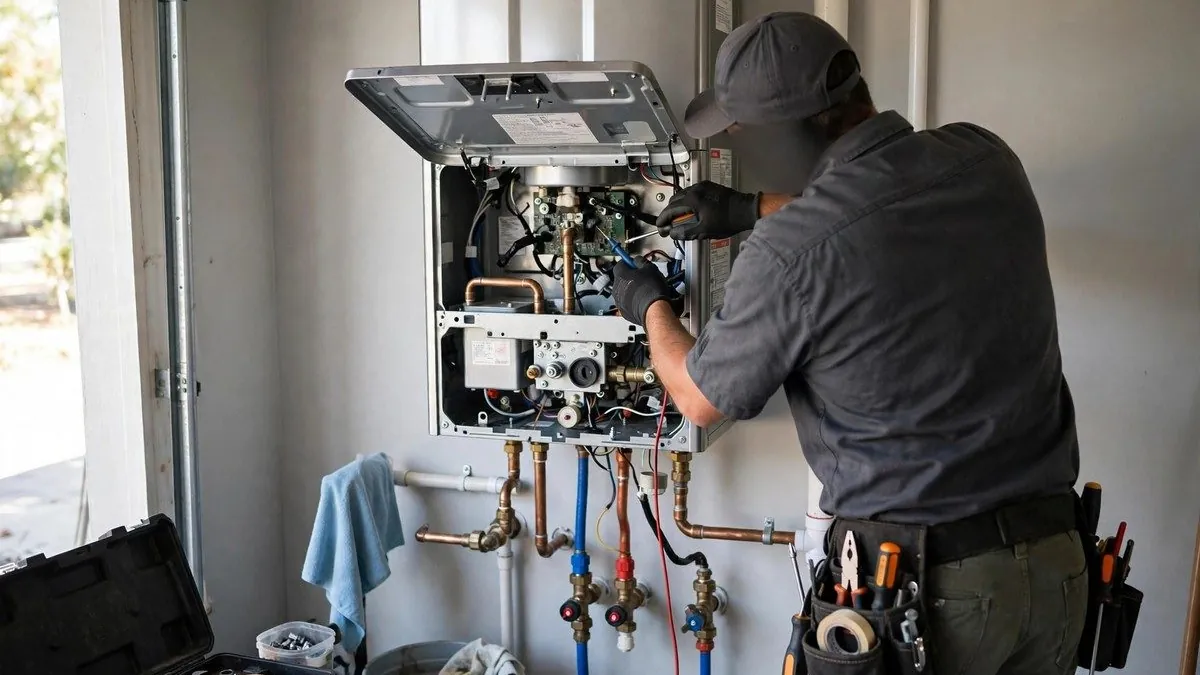
The two numbers that decide the size
Every tankless sizing job starts with two questions. How many gallons per minute will run at the same time at the busiest moment? And how many degrees must the water rise between the pipe and the tap?
The first is flow rate. The second is temperature rise. Multiply them together, apply a constant, and you get the heat the unit must deliver every hour. Everything else in sizing is a refinement of those two inputs.
The formula in plain terms
The formula is one line, and each part has a plain meaning. Here it is, followed by where the constant comes from.
BTU per hour = flow rate (gpm) x 500 x temperature rise (F) / efficiency
The 500 comes from physics. A gallon of water weighs about 8.33 pounds, and it takes one BTU to raise a pound by one degree. Multiply by 60 minutes in an hour and you get roughly 500 BTU per hour for each gpm and each degree of rise.
Efficiency is the unit's thermal efficiency written as a decimal, such as 0.95. Dividing by it turns the heat delivered to the water into the heat the burner must supply.
The result is the input rating you compare against the label on a gas unit. An electric unit is rated in kilowatts instead, and one kilowatt equals about 3,412 BTU per hour.
Step one: add up the flow you will run at once
Do not add up every fixture in the house. Add up the fixtures you will realistically run together. For most families that is one or two showers plus one more tap, a dishwasher or a washer.
| Fixture | Typical flow (gpm) |
|---|---|
| Low-flow shower head | 1.5 to 2.0 |
| Standard shower head | 2.0 to 2.5 |
| Kitchen faucet | 1.5 to 2.2 |
| Bathroom faucet | 0.5 to 1.5 |
| Dishwasher | 1.0 to 2.0 |
| Clothes washer | 1.5 to 3.0 |
The numbers vary by model and age. Look for stamped flow rates on shower heads and faucets. If you cannot find them, a bucket and a timer give a decent estimate.
Step two: find the temperature rise
Temperature rise is the target tap temperature minus the temperature of the incoming water. Most people set the tap near 120 degrees. The incoming water is colder in winter than in summer, so size for winter.
Measure it rather than guessing. Run a cold tap for a couple of minutes during a cold spell and use a kitchen thermometer. A unit sized for a mild day will struggle in January.
Worked examples
Assume a 70 degree rise, such as 50 degree incoming water and a 120 degree tap, and a unit that is 95 percent efficient. The first line below is the simple case.
| Scenario | Flow (gpm) | Calculation | Input needed (BTU per hour) |
|---|---|---|---|
| One shower and a bathroom tap | 3.0 | 3.0 x 500 x 70 / 0.95 | about 110,000 |
| Two showers at once | 5.0 | 5.0 x 500 x 70 / 0.95 | about 184,000 |
| Shower and kitchen tap | 4.0 | 4.0 x 500 x 70 / 0.95 | about 147,000 |
| Same two showers, 80 degree rise | 5.0 | 5.0 x 500 x 80 / 0.95 | about 210,000 |
Notice how a ten degree drop in incoming water adds a lot of required input. That is why the winter measurement matters, and why the same house can need a bigger unit than a neighbor with the same fixtures.
Want a sizing check on your own house?
Call (973) 488-5410 and we will walk through your fixtures and your winter water temperature.
Why electric tankless often cannot keep up
Convert the examples to kilowatts. A requirement of about 110,000 BTU per hour is roughly 32 kilowatts. Two showers at once approach 54 kilowatts. Most houses do not have the electrical service to power a single unit that large.
Electric tankless works well in small, point-of-use roles such as a single sink or an apartment with one bathroom. For a whole house with several bathrooms, gas is the more practical fuel.
Gas lines and venting have to match the unit
A big BTU rating is no help if the gas pipe cannot deliver the fuel. Many houses have a gas line sized for a tank water heater. A tankless unit can draw several times that input, so the line may need to be upsized.
Venting is the second hurdle. High-efficiency tankless units usually vent through plastic pipe to the outside, and the run length and number of elbows are limited. Combustion air is part of the plan too. This is the main reason a visit and a measurement matter before a purchase.
Can a smaller unit work?
Yes, if you accept limits. A unit sized for one shower can serve a household that never runs two at once. A mixing valve or low-flow heads can stretch a unit's capacity. What you lose is the freedom to run the dishwasher during a shower without feeling it.
Another option is to install two smaller units or a unit with a recirculation loop. A good installer will show you the trade-offs instead of simply picking the biggest number.
Code that applies to an installation in Ridgewood
New Jersey's Uniform Construction Code adopts the 2021 National Standard Plumbing Code as its plumbing subcode, under N.J.A.C. 5:23-3.15. That is the state rule the village enforces through its Department of Building and Inspections, which includes a Plumbing Subcode Official.
Sizing, venting and gas piping should be done to the codes in force, and by a licensed master plumber or authorized contractor under New Jersey rules. Ask your installer to show the load calculation and the vent plan before the job starts.
Source type: New Jersey Administrative Code (state regulation) and Village of Ridgewood Municipal Code, Chapter 125
Other things that change the number
The formula gives a starting figure, and a few real-world conditions can move it up or down. Keep these in mind during the site visit.
- Low water pressure reduces the flow a fixture can deliver, so the real flow may be below the label.
- Hard water scale reduces efficiency and can cut flow through the heat exchanger. Plan for a yearly flush.
- A recirculation pump improves how fast hot water arrives but may need a larger unit or a buffer.
- Future bathrooms or a hot tub change the load. Size for what you plan to add.
- Natural gas and propane units are not interchangeable without a conversion, so confirm your fuel.
Putting it together
Here is the whole method in order. Work through it with your own numbers and you will have a figure to compare against any quote.
- 1
List the fixtures
Decide which will run together at your busiest time.
- 2
Add the flow
Add the gpm numbers. Use label values or a bucket test.
- 3
Measure the rise
Use winter incoming temperature and your target tap temperature.
- 4
Run the formula
Multiply flow by 500 by rise and divide by efficiency.
- 5
Check the gas line and vent
Confirm the line size and vent route can support the result.
Our tankless water heater team does this calculation on site and checks the gas line before quoting. For the full job we handle water heater installation from line sizing to final test, and a unit that needs service falls under water heater repair.
If you live in Glen Rock or Wyckoff, we do the same visit there.
Sizing a tankless heater?
Call (973) 488-5410 and we will check your numbers.
Questions homeowners ask
There is no single answer. The examples above range from about 110,000 to over 200,000 BTU per hour, and your number depends on your fixtures and winter water temperature.
Gallons per minute is the amount of hot water the unit can deliver at a given temperature rise. The number falls as the rise gets larger.
A bigger unit costs more and may need a larger gas line and a longer vent. Oversizing is wasteful. The right size is the one that meets your real peak demand.
Hard water scale builds up in the heat exchanger and lowers flow and efficiency. Ask your installer about a yearly descaling flush and check the current Ridgewood Water report for your area.
New Jersey's plumbing subcode adopts the 2021 National Standard Plumbing Code, and the work has to be done by a licensed master plumber or authorized contractor. The village building department handles the permit side.