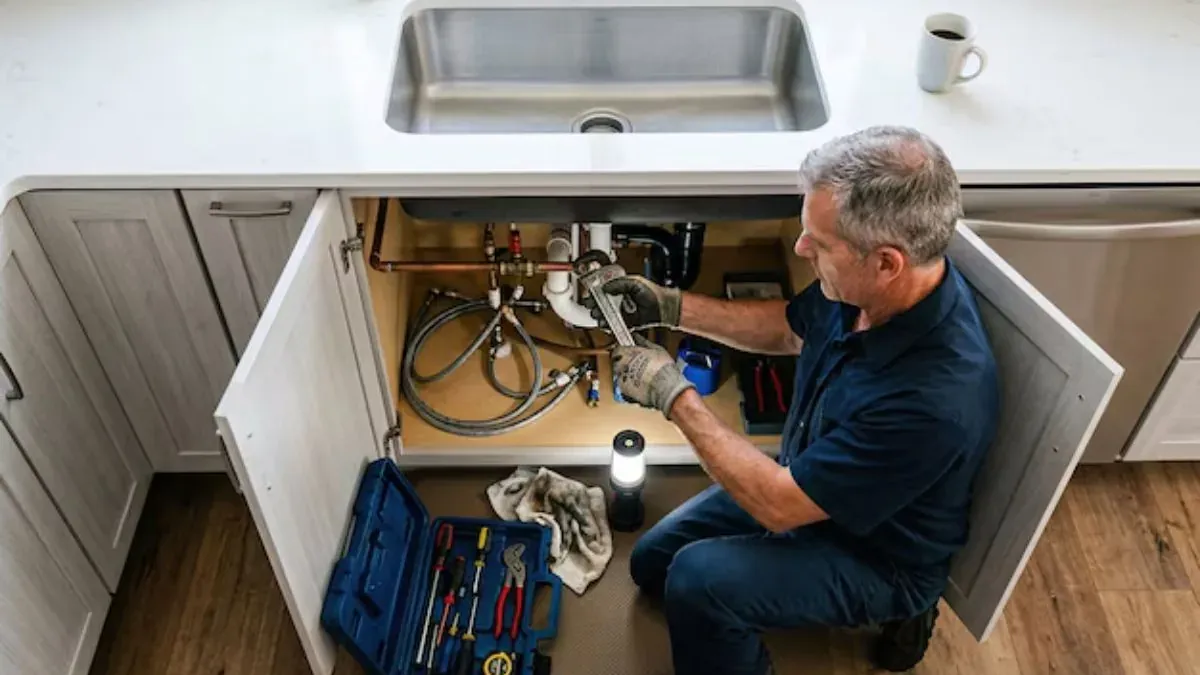
What counts as plumbing installation
Installation is new work, as opposed to repairing something that broke. It covers adding a fixture, moving one, hooking up an appliance and building the supply and drain lines for a space that did not have them.
If something is already failing, our leak detection and repair pages fit better. If you are replacing a heater, see water heater installation. This page is for the rest of the planned work.
Bathroom fixtures
Toilets, vanities, showers, tubs and the valves behind them.
Kitchen and bar sinks
Faucets, dishwasher hookups, disposal connections and pot fillers.
Laundry hookups
Washer boxes, standpipes, drain lines and utility sinks.
Remodel rough-ins
Supply and drain lines in open walls and floors before they close.
Outdoor and utility
Hose bibs, frost-resistant spigots and basement utility sinks.
Planning the rough-in before the walls close
Rough-in is the stage where pipes are placed inside open framing. Mistakes here are expensive, because fixing them means opening finished surfaces. Decide fixture locations, vanity sizes and shower valve heights before the plumber arrives.
Bring your contractor, designer or tile setter into the conversation early. Venting, slope for drains and framing clearances all influence where fixtures can go. A drain that needs a quarter inch per foot of fall can limit a basement bathroom more than any design choice.
Planning a remodel or an addition?
Call and walk us through the plan. We will tell you what the plumbing needs before work begins.
Code, licensing and inspections in New Jersey
New Jersey's Uniform Construction Code adopts the 2021 National Standard Plumbing Code as its plumbing subcode. That is the standard your work is inspected against. Ridgewood's Department of Building and Inspections enforces it, with a Construction Official and a Plumbing Subcode Official.
State law allows plumbing to be done only by a master plumber or an authorized plumbing contractor, or by employees of one. You can check a license on the Division of Consumer Affairs' online verification portal. Licenses renew every two years, so ask for a current one.
The code treats some work as minor. Adding new fixtures in existing dwelling space, without increasing the size of the water service or the house drain, counts. The agency must still be notified, a permit application filed within five business days and the work inspected. Bigger changes need approval before work starts, and we sort out the category up front.
Older Ridgewood neighborhoods and what a remodel can uncover
The Ridgewood Public Library's local-history pages date Brookside to about 1890, The Heights to between 1892 and 1930, and The Lawns to 1950, when 429 Cape Cods were built on Grove Street. Homes from those eras have seen decades of changes behind the walls.
That has a practical meaning for an installation. When we open a wall for a new bathroom, we may find supply lines, drains or vents of different ages and materials. We assess what is there before tying new work to it, and we tell you if a section should be replaced while the wall is open.
The installation sequence
- 1
Site visit and scope
We look at the space, the existing lines and the fixtures you chose, and confirm what the job needs.
- 2
Permit and notice
We take care of the filing and schedule the inspection stages.
- 3
Rough-in
Supply, drain and vent lines are placed, then pressure and leak tested before covering.
- 4
Fixture set
Once finishes are in, we set and connect fixtures, test shutoffs and check drains.
- 5
Final inspection
The agency inspects, and we leave you with the shutoff locations and fixture details.
Doing it new versus adapting what is there
Adapting existing lines works when
- Fixtures are moving only a short distance
- Old piping is in good condition
- The drain slope and vent are adequate
- The job is a one-for-one swap
New lines make sense when
- You are adding a bathroom, kitchen or laundry
- The existing pipe is galvanized or leaking
- Fixtures are moving to another wall or floor
- A layout change needs new venting
When older supply pipes are the problem, a bigger repiping project may save you from opening the same wall twice. If water reaches a basement, see basement waterproofing before you finish that space.
What affects the cost of an installation
Pricing factors
Installation quotes are built from a handful of variables.
Call and describe the project. We give a clear price before work starts.
Our service area includes Waldwick and the other towns around Ridgewood, so the same crew can handle remodel plumbing across them.
Ready to plan your installation?
Call and tell us what you are building or changing. We will walk through the plumbing before any work begins.
Plumbing installation questions
Often yes. Even work the code classes as minor requires notice to the enforcing agency, a permit application and an inspection. We handle the paperwork.
Yes. We coordinate rough-in and fixture-set dates with the contractor so inspections and finishes stay on schedule.
Either works. If you buy them, check that they fit the rough-in and have all parts. If we supply them, we match them to the plan.
Often, but drainage is the issue. If the drain is below the sewer line, a pump system may be needed. We check before you commit.
We connect the plumbing side, meaning supply, drain and shutoffs. We set dishwashers, washer boxes and similar hookups, and the appliance itself is usually delivered and positioned by the seller.
Before demolition. Plumbing placement affects framing, cabinets and tile, and early planning avoids rework.